“We can’t form our children on our own concepts; we must take them and love them as God sends them to us.”
– Hermann und Dorothea, 1797
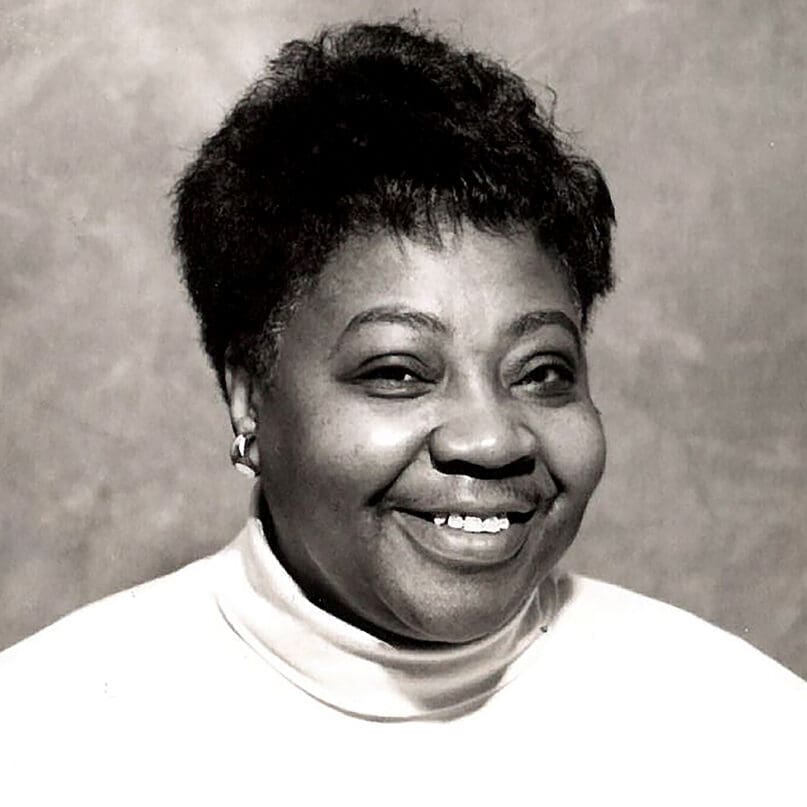
“The word “Mongoloid,” I had heard the word “Mongoloid,” but I really thought it was a monster. I didn’t know what a Mongoloid was. And I said, ‘Are you going to let me see the baby?’ And they did show the baby to me…and she looked alright to me.”
– AHRC Board Member Thelma Ragland, remembering the birth of her daughter with Down syndrome
The origin of AHRC is not to be found in its formal history, incorporation documents or public papers. It begins, instead, with the birth of children with mental retardation in New York City during and after World War II.
The founding parents’ experience of the birth, diagnosis and early years of their children is perhaps the best way to understand why they came to form AHRC. It is indicative of the experience of so many thousands of other parents in similar circumstances at that time. The following brief narratives, constructed from interviews and video tapes, present several founding parents’ memories of their child’s birth. These are followed by a narrative of a younger couple, one of whom is a member of the AHRC Board today, describing the birth of their daughter with Down syndrome in 1988. While certain similarities between older and younger parents’ narratives are evident, the stark contrasts between them leads us to the central questions that will occupy the remainder of this writing. How did society change so as to produce the differences in these generation’s experience of the birth of a child with retardation? And, what was AHRC’s central role in producing those societal changes?
The Founder’s Children
Jerry Greenberg
Ann Greenberg’s son, Jerry, was born during the War and was not part of the baby-boom children whose parents were ultimately to become the backbone of AHRC. Jerry was born a beautiful baby without any suspicion of disability from either family or doctors. During the war, while her husband was in the service, Ann lived in her mother’s home with her sisters. When Jerry was about five months old, she and her sister went to visit their brother, also in the Army and then stationed at Fort Dix. In a recent interview Ann describes her return home that day.
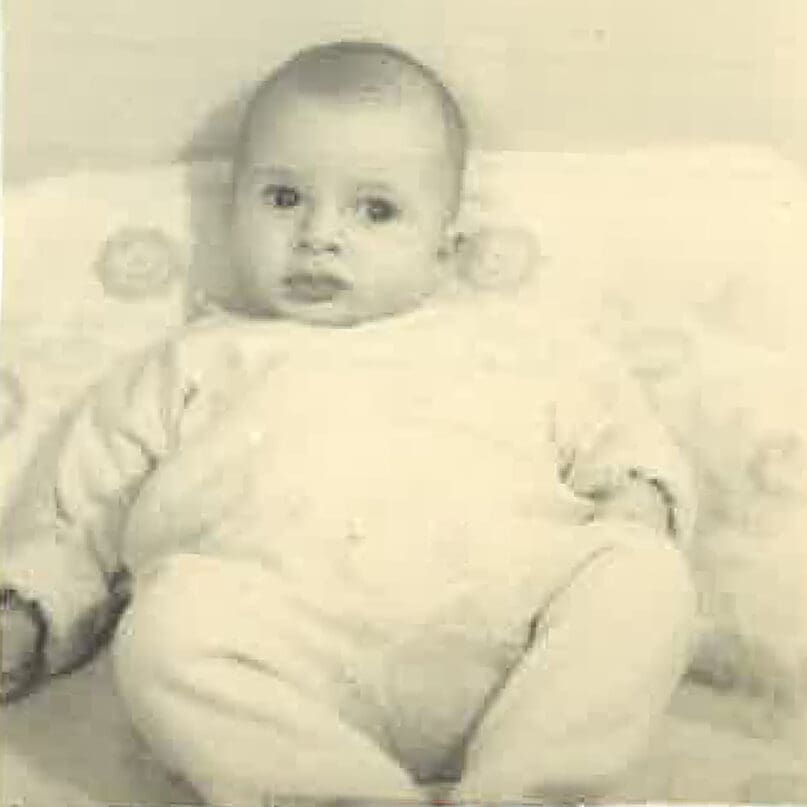
Archival photo of Jerry Greenberg at 3 months
“We came back that day, my mother said to me there’s something wrong. He seems to be…it looks like he is in pain of some kind. He was about five months old. I didn’t know what that meant, but what he was doing was stiffening up. He wasn’t losing [consciousness]. He was stiffening up…So then we started with the doctors and hospital, the Presbyterian Baby Hospital. My doctor, who delivered him, and nobody else could figure out what it was. I kept a record of how many times a day this happened…I got $80 a month for the baby…and I was spending it on doctors and nobody could figure out what it was.
One day we went to the Baby Hospital clinic, my mother took me. He never had the episodes when the doctors could see it. So they had to go by what I said. I laid him down on the table and this doctor looked at me and said to me, ‘His brain has been injured. He’s retarded. Go home and have another baby.’ (Pauses) I never forgot him. I looked at him with a face like, you know, I don’t understand that. So he repeats. ‘Go home and have another baby.’ First of all, I can’t go home and have another baby; my husband is in the war. Secondly, I am not interested in having another baby, only the baby on this table. So he says, ‘Well, that’s all I can tell you. We can’t help him.’ And he walked out. I tried other doctors, private doctors, you know there was no clinic for retarded children.”
Ann tells of her continuing saga of seeking doctors to help her with Jerry. She was lucky in the sense that Jerry and she lived in a “home filled with love.” Jerry had several loving caretakers, she, her mother and her sisters. But despite their efforts, Jerry had serious seizures at about the age of twelve months.
“I was writing a letter to my husband, like I did every single day, and my mother called me. There is something wrong with Jerry…He had convulsions…I called the doctor up and said, what do I do? He never had this before. He said, ‘Put him in the bathtub with warm water.’ My mother and I rushed him into the bath with warm water…An hour or so later, it happened again, we did it again. Do you know, that never happened any more, after that.”
Whatever the cause of his condition, Jerry developed slowly.
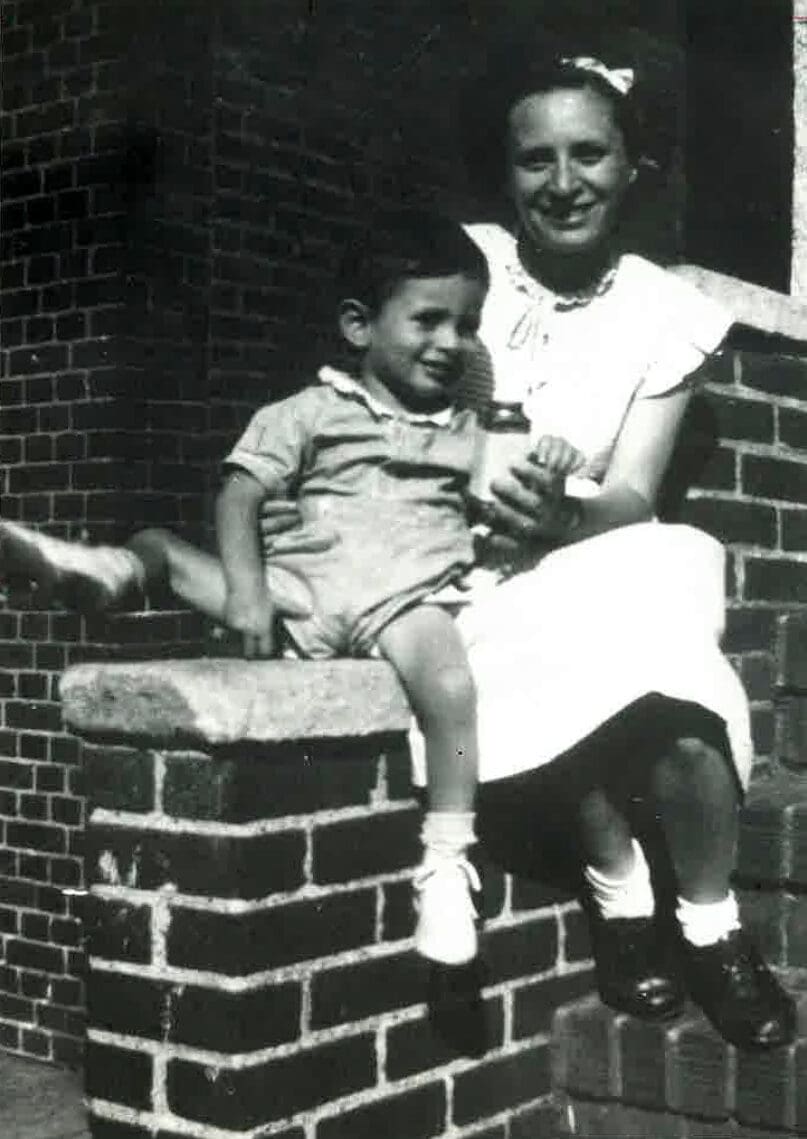
Ann Greenberg with Jerry
“It took him longer to walk, it took him longer to learn how to walk. Then he showed all those signs and was hyperactive. If he wasn’t hyperactive he’d be alive today. Then the doctors were giving me (pheno)barbital.”
Unfortunately this drug was not good for Jerry. He became even more agitated, remained awake for 24 hours, and then was depressed. Ann remembers that Jerry stopped smiling when he had the seizures and was taking phenobarbital. She remembers him starting to laugh again after she stopped giving him phenobarbital.
“We ran up on the roof, my sister, she’s wearing her house coat, half- undressed…we took a picture…He’s finally smiling again. She took him, she showed him over her shoulder, I’ll never forget that picture. And from then on he was himself again.”
Despite the family support system that Ann had, including her husband when he returned home from the war, there were no services for Jerry and this made Ann begin a personal campaign of letter writing that, for many reasons, blossomed into the parents movement in New York City– and eventually took the form of AHRC in 1949. Much of that story will be told in Ann’s own words in the next section. What was avoided by Ann for the most part in her interview were the particulars of the tragic death of her son at the age of eight. She was able to say this much, and with great feeling behind her words, as if the event were yesterday and not almost fifty years ago.
That is when I lost my son…it was a public building [i.e., the building could not be locked] and he walked out the door. By the time they found him it was too late.”
Jerry died by drowning. Even though this tragedy occurred and Ann and her husband had another ‘normal’ child soon after Jerry’s death, she remained committed to AHRC and the other parents with whom she felt kinship. At the time of this writing, Ann, in her eighties still comes to AHRC each day to work in the mail room.
Lisa Pendler
Betty Pendler has been a Board Member of AHRC and has been an active parent in the parents’ movement for forty years. She is well-known nationally as a parent-advocate and continues to participate in some of the most innovative and interesting projects in the field of mental retardation. She is moving and incredibly honest about her own experiences with her daughter Lisa, who was born with Down syndrome. The following brief narrative is taken from a 1991 AHRC training video, “Communicating with Families.”
“When my husband and I got married we had never heard of the term Down syndrome. We didn’t know anything about Down syndrome. This was the first baby and very much wanted baby. But I had three girlfriends also who had married late in life and who had children. And one of my friends noticed that obviously there was something wrong. She suggested that I go to see her doctor instead of the doctor I was using. Contrary to my husband’s advice I went to see this doctor and that was a very devastating experience. The doctor held her up like a plucked chicken and pointed to the various symptoms of Down syndrome and then told me that since she was a girl, my husband and I should consider putting her away. I came home that night and I was absolutely devastated. And I remember my husband saying to me, ‘Well, I want to ask you Betty, yesterday you didn’t know she was retarded and today you do. Is she any less precious to you today than she was yesterday?’ And my honest answer was…yes. And I immediately went into throws of depression and all kinds of emotions as a result of that.
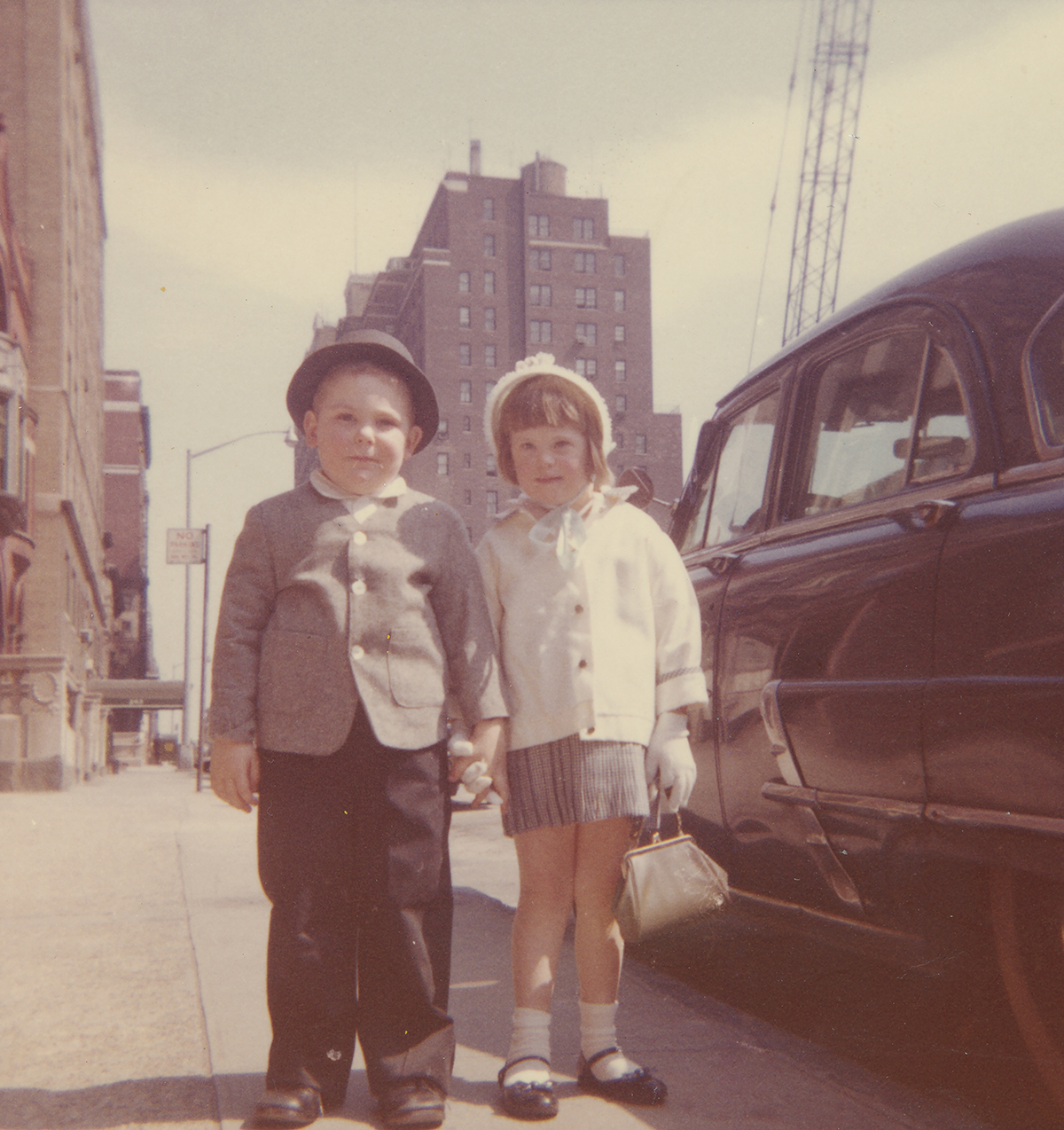
Childhood photo of Lisa and Paul Paendler holding hands on the street
My darkest thoughts were on the first night when we discussed it. And I asked, how I was going to go on? My dreams had been shattered in one fell swoop. Neither one of us had been married before and this was a very much wanted baby. I had dreams of having a daughter who was going to be my friend. And I immediately felt that I wasn’t able to go on. I immediately felt how nice it would be if I were dead. I felt how nice it would be if she were dead. And for the next few weeks I went through horrendous emotions. When I took her to the pediatrician I actually contemplated jumping into the pit of the subway. And I remember my husband not believing me when I said to him, when I was giving her a bath in the bassinet, that I was tempted (stammers) to fill up the water all the way. Thank goodness I didn’t cause Lisa is just a wonderful human being! But those were the emotions I felt at that time.”
Betty Pendler was not only able to overcome these early feelings but has been mother and friend to her daughter Lisa, who now lives in an AHRC residence. Betty has been a staunch advocate for her daughter and other persons with retardation. In her speeches she emphasizes how she was often overprotective of her daughter, and how when parents protect their children too much, they are not really helping them at all. In fact, she says, they are hurting their children to protect themselves. Betty is a very self-aware woman, perhaps having something to do with her having been Lisa’s parent.
Peter Gramm
Eugene Gramm, parent of Peter Gramm, was a figure in the early years of AHRC, an early elected officer responsible for much of the public relations done in the first years. The following is taken from a recent interview with Gene about the birth of his son.
“Peter’s mother underwent an emergency Caesarian in the eighth month because of the condition called placenta previa. This could result in the child’s death. Peter was born unconscious and blue. He was resuscitated and the general conjecture is that there was deprivation of oxygen to certain centers of the brain that resulted in his retardation…There were no overt signs, no stigmata or anything of that kind. We began to get that sinking feeling that other parents of retarded children know about very early on, when we could see that he lay kind of inertly in his crib and that all the distractions, all those wonderful rattles and toys, colorful and noisy things that bring smiles to other infants, had no effect on him whatsoever. So gradually it dawned on us that he was retarded… that was in 1943.
“We went to physicians early on. You know physicians. When things can’t be determined they like to take the optimistic view so we had reassurances all the way up to the point where it began to be evident that there was something significantly wrong. The first real blow to the solar plexus was when our general practitioner sent us to a psychiatrist who, in the terminology of 1943, said, ‘Your child is a moron.’ And then he said, ‘Don’t feel too badly about the term because we use it in the medical profession.’ But I was aghast at the term. Totally ignorant of all this. I’m 78 right now and I was 23 years old then and I said, ‘Why do you use that term?’ He said, ‘Well, there are three terms and your son is in the upper class. We have idiot, imbecile and moron.’ Something struck me as being terribly wrong, unmedical and medieval about all that but that was the way it was, as I later discovered when I read the AMA journals. So here we have these two distraught, very young parents with a little boy walking the streets of Brooklyn– he was now, I would guess, about three years old– with tears streaming down our faces and totally at a loss, feeling very much alone in the world.”
As with the Greenbergs, the Gramm’s found no community or residential services available for their son.
“The problem that we began to have as he gained more physical capabilities, even rudimentary speech, was hyperactivity. He became terribly active, hyperactive, and twice, not once but twice, threw himself through the window. Right through the glass pane and everything. Fortunately we lived on the first floor.
He was so active he had to be tied down in his crib at night and we’d do it with a soft belt from a bathrobe. After a while he would hold up one little leg in order to be tied down that way. As he got older, he was approaching five, he began to shake and even uproot radiators. He had enormous strength for a diminutive boy. It started to become a terrible problem but still one we thought we’d cope with and accept.”
But, as Gene said in the interview, life is full of surprises and the almost complete nervous breakdown of his wife was certainly one of these. This occurred in the early 1950’s, in the early years of AHRC.
“I was struggling with Peter and she was having nervous breakdowns and resting in bed. He was uprooting radiators. I had to go to work… (upset ) If I could have stayed at home I never would have done that. One of the ghastly mistakes of my life. I didn’t know what alternative I had. My family had all fled to California…to this day I still give it a neurotic interpretation…. I finally capitulated and applied to Letchworth Village to get him placed there. There was a long waiting list and I was in a state of crisis. So I went to Jerry Weingold [first Executive Director of AHRC, see below- DG] and Jerry Weingold had some pull at that point but was opposed to it. God rest his soul but he said, ‘I don’t know what alternative you have Gene, so I guess you have to.’
Weingold was able to get Peter into Letchworth Village despite a waiting list. Gene recalls he and his wife bringing him up to Letchworth when he must have been about ten years old.
“[We] walked away with his screaming in our ears and they told us please don’t come back for at least six weeks. He needed his adjustment time…It was a hot July day, it was one of those moments in life that stay with you forever. We both sank down in the grass in front of a church and wept copiously in each other’s arms. And we went back and she went back to bed for more weeks…”
While the story of Peter at Letchworth was not a happy one, despite numerous incidents and even being run over by a physician, Peter survived Letchworth. He lived for many years in an AHRC residence and attended AHRC programs (although at the time of this interview he is in a nursing home after a serious fall). It was clear in the interview that Gene still felt tremendous guilt and sadness over his decision. He expressed this most touchingly when he described Peter’s poetic tendencies.
“He has said things that are so wonderful…like when a breeze ruffled the pages of the book we were reading and he said, ‘Now the wind is reading my book.’…All these wonderful things he had to say and feel. That’s all lost, kind of down the drain.” (very upset quickly moves to another topic).
Gene, as many of the founding parents, had many memories that plagued him, and he was still not at ease with what he had decided on Peter’s behalf.
A Younger AHRC Board Member’s Child
Melissa Riggio
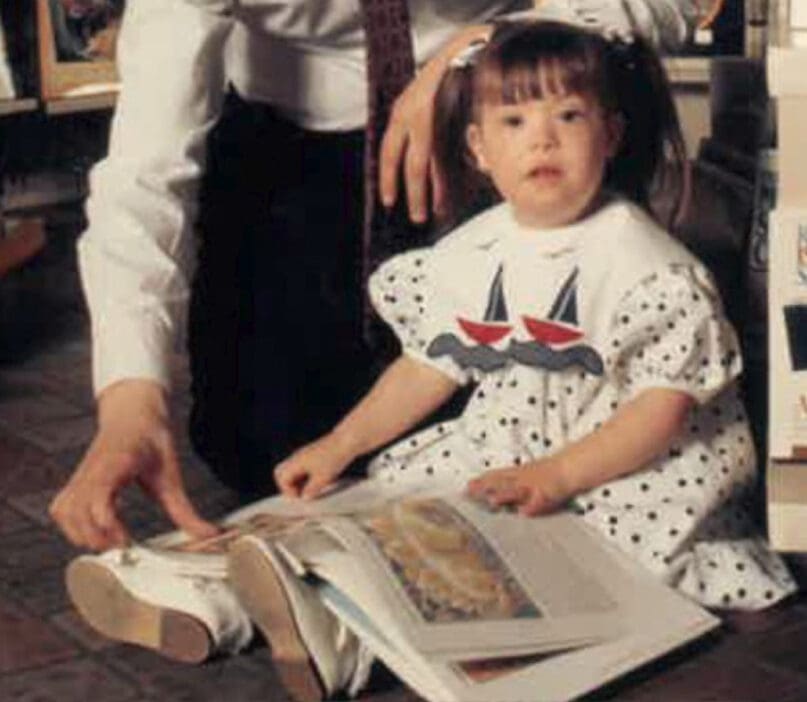
Childhood photo of Melissa Riggio
Melissa Riggio is the ten-year-old daughter of Steve and Laura Riggio. Melissa was born in 1988 with Down syndrome. Her father Steve, Vice Chairman of Barnes and Noble bookstores and other book chains, is currently one of the younger parents who serve on the AHRC Board of Directors. Steve and Laura also have an older daughter, Laura who is twelve, and a younger child, Christina, seven. Unless otherwise specified, the following is taken from Laura’s narrative.
“Everything about the pregnancy had been normal. The tests were all normal, so there was nothing to indicate anything was out of the ordinary with the pregnancy. And it was a fairly easy birth. I didn’t have to be cut. I didn’t need to take anything. Our first was born naturally but I needed to have Demerol and it was quite painful. With Melissa, the birth came more quickly than even the doctor had anticipated. I had to be induced, but I have had to be induced with all three of my children. The only thing at first that kind of alerted me that something might not be right, was at first when they let me hold her, her coloring was not quite right. It was kind of dark. So when I questioned it they said she might be cold and they bundled her up. And then another nurse came in and said, ‘Was she born with the cord around her neck?’ And I said, ‘No.’ So they said she might be cold, cause at that point the doctor leaves and lets you bond with them. And I was looking at her, and I noticed, but really did not think anything, that she seemed to have two extra folds in her neck, at the sides. But being a mother I just noticed and didn’t think anything of it. I can’t say that she had features at that point that would alert us that something was wrong, and I’m a teacher so I think that if her features were very pronounced that would have been something I would have worried about. At that point we were just like bonding, not knowing anything was wrong. And we went back to the room, I think she was born at four, and at six they usually bring them for feeding. At the six o’clock feeding they didn’t bring her and we kind of said to ourselves, ‘she was just born, maybe they are still working on her, weighing and doing all that’… The doctor came in and said, ‘Was there any history of diseases, in your family? Did you take any drugs during pregnancy?’ To which I said, ‘No’ and asked, ‘Why, is there something wrong?’ He said, ‘Well no. The baby seems to have some unusual features but everything is fine.’ Now my pediatrician doesn’t practice in that hospital and I was using a neonatologist to come in and examine her, but he wasn’t available till the next day, so we were kind of on our own at that point.
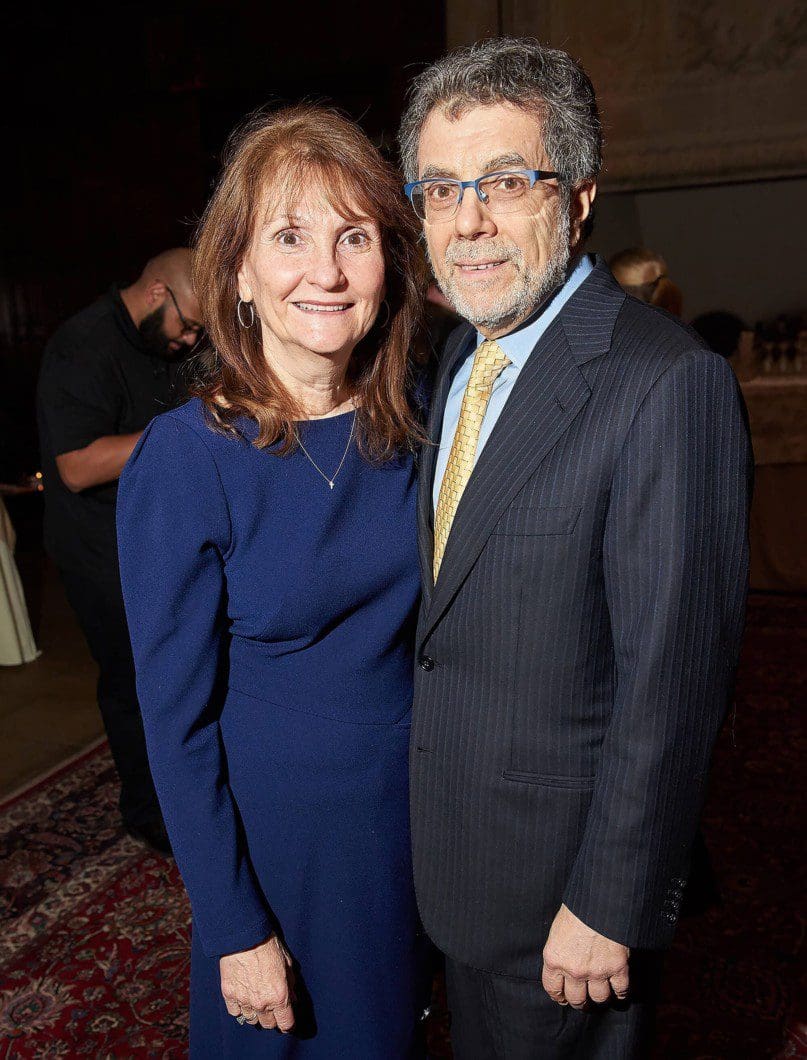
Melissa Riggio’s parents, Laura and Steve, 2019
“By the time the second feeding came, after him asking those questions, something went off in my head that something is amiss here. And when I walked to the nursery I noticed a lot of people poking and prodding her. And when I questioned them they said, ‘No, no. Everything is fine. We are just examining her. And I remember saying to Steve, ‘I think something is wrong.’ And he said, ‘Oh no she’s fine. She’s beautiful.’ But by the second feeding I am frantic. And my obstetrician sees me in the hall and says, ‘What’s wrong? Why aren’t you in with the baby?’ And I said, ‘Something is wrong. They won’t bring her to me.’ And he said, ‘What do you mean something is wrong?’ I told him that they were all looking at her and examining her. With that he told me to go back to the room and that he would be right back. He closed the door and outside proceeded to scream at the Head Nurse that she better get our baby. And they brought her for the feeding. But at that point I was pretty upset. Something was definitely wrong. And when they took her back I asked my doctor what was wrong and he said that they were looking for some syndrome. We are not really quite sure what it is, your neonatologist will be in the next day to examine her. So we had to wait till the next day. At that point Steve was really reassuring — he kept on saying she is beautiful, she is just like Laura, and nothing is wrong. But I just kept on having this nagging thing. If everything is alright then why are they not bringing her? Why is everyone milling around her?
“And then the next day the neonatologist came, examined her and came in and I said, ‘Really I have the right to know. I’m her mother. What is going on?’ And he said, ‘We think there might be chromosomal abnormality.’ And I asked what he was talking about. I went through the list of the few that I knew. But he said, ‘I really can’t say exactly what it is because your daughter seems to be borderline. She has certain features which would lead us to believe that she has this abnormality. But there are certain other things she doesn’t have. And the only way we’ll know for sure is if we do this chromosomal study on her.’ So they let me go home that day and we had to come back the next day to have the blood drawn for the chromosomal study. And that took about ten days to get the results. And even at that they had promised us that someone would call us within ten days. No one did so I called and they told me that they hadn’t finished growing all of the cells. They had only grown ten and they liked to grow sixty. At that point we had already visited our pediatrician, and told him that they want to do this chromosomal study, and he was quite frank the night that we visited him after he had examined the baby. He said that they were looking for “‘Mongolism,’ which was surprising because he was a pretty young pediatrician and that’s a very antiquated term. But he said they are looking for that and that is because there are sixteen features and your daughter has eight that they can see. But the features are so soft that it is very hard from just looking at her to tell. While her muscle tone was low, he had seen babies with looser tone that didn’t have Down syndrome. So he recommended the best thing to do is to have the study done.
“So after ten days I call at the clinic and they said they haven’t been able to grow sixty cells, only ten. But by that point Steve and I had done some reading and I said, ‘Well if it is in every one of the ten cells the likelihood is it will be in the other fifty, we have a right to know. So she said come in and we will have someone tell you the findings. At that point they did tell us, I don’t know if she was a social worker or what, she wasn’t a doctor. She did sit down and say that it was trisomy-21 and it was in all of the ten cells. She explained it to us the best that she could and then gave us the names of a couple of infant stimulation programs and told us that at this point in her life that was really the best thing that we could do. So I think at that point I was upset about it, Steve was really upset about it. But we had already known from the reading that we had done that the best thing that we could do was to get her into some kind of infant stimulation program, as soon as possible. So she literally was accepted into a program and started by the time she was three weeks old.
The Riggios were asked whether they had experienced any shame or guilt after Melissa’s birth. Neither did. Laura said that she had taken very good care of herself during the pregnancy and there was really nothing more she could have done in terms of prenatal care for Melissa.
“I did have feelings of why me? Not guilt or shame, but doubt as to why it happened to me. But I went to the infant stimulation program and I met other young parents and we would talk about it in the parents support group. I would look around and think, what do we all have in common? Why did this happen to us? What is the missing link? In terms of shame, well, I guess at first I did not know who I could tell. You go through all sorts of stages. You know, you don’t want to tell anyone, then you feel like you kind of have to tell everyone. And then you just have to come to terms with it. But I don’t think we felt a sense of shame or guilt.”
Steve Riggio added,
“You go from this feeling of why me to very quickly this overwhelming sense of responsibility to take action. Because it is not really why me? It is, why her? She has got the condition not us. But we did feel that we were dealt an overwhelming responsibility and you just have to wake up and face it. No shame, but just that we have to do everything we can.”
In an interesting comment Laura shared that she had anger, but not at the birth so much as the time they had to spend reading and becoming disabilities experts where they normally would have been able to enjoy their baby. She felt that this part of Melissa’s infancy was kind of taken away from her and the family. It took the family a couple of months until they could actually enjoy her, open baby gifts and so on. She admitted a certain amount of depression in coming to terms with Melissa’s disability in the first months of her life. But as she came to terms with it Laura felt she should have been happy about her child, the same way as if she had not been disabled.
The Riggio’s family accepted Melissa’s birth after the initial shock wore off. Steve’s mother was very supportive, as were both their brothers and sisters. Melissa went from her infant stimulation program to an inclusion [end note 1] program in a local Catholic school. She is in a regular third grade class and going into fourth grade. Of course there have been problems, as with all children, and Laura says she takes it day by day, working with the school as a team. Melissa has some problems reading, but with the aid of a calculator is keeping up in math. Significantly, she has friends with and without disabilities with whom she socializes regularly outside school. The school is very supportive of educational inclusion and for the five years she has attended the Riggios have never had an experience where Melissa was made to feel that she shouldn’t be there. No one ever expressed any resentment or upset at her presence in class. Melissa has thus far had a very normal educational experience for a girl her age. However, the Riggios are moving soon and Melissa will attend a public school in a school district known for supporting educational inclusion. They are hoping that Melissa will continue to have a positive and integrated education along with her peers.
Discussion
All human experiences, from the most trivial to the most profound, have features that are common to everyone, as well as features unique to the particular individuals involved. I have heard many parents of children with retardation over the years discuss what it was like to find out their child had a disability and I never heard anyone refer to it as a joyful and happy experience. This has been almost universal. Another thing that has not changed in the forty years between the births of Jerry Greenberg and Melissa Riggio is the sadness, depression, and feelings of ‘why me?’ that are noted above. There are also similarities that one might not expect to be there, for example, the fact that in the 1980’s the Riggio’s young pediatrician also used the antiquated and stigmatizing term ‘Mongolism’ to describe their daughter’s condition. In comparing these narratives I am not trying to say that there are not parents today who experience very intense reactions to the birth of a child with disabilities, as did Betty Pendler when Lisa was born. Nor am I implying that there are no longer places and sub-cultures in the United States that are particularly unaccepting of children with disabilities.
What is glaringly different in the young parent versus older parent narratives is the current availability of information, diagnostic services, early intervention services, parent support groups and inclusive educational services that were entirely absent, indeed not even in the imagination of the most forward thinking parents and professionals, when Jerry Greenberg was born. In addition, the mainstream societal attitudes and stigma related to disability have so changed since Jerry’s birth that neither Steve nor Laura considered these a major problem. This clearly was not so for the older parents and their children. Ann Greenberg recalled a conversation with Jerry Weingold’s wife back in the late 1940’s in which Mrs. Weingold told her that she always placed her “Mongoloid” son Johnny face down in the carriage when they went outside, and how ‘lucky’ Ann was that Jerry was a pretty baby. This is precisely the kind of acute stigma that was described in an article in the October, 1943 edition of Parent’s Magazine (the year of Jerry Greenberg’s and Johnny Weingold’s birth) written by “a Mother Who Wishes To Be Anonymous.” She stated, “…we know that many parents must choose between not taking a child out with them and braving the curious, pitying stares of the passers-by.” [end note 2] These kinds of references are myriad in magazine articles of this era. Also, as part of this history the author interviewed residents of AHRC’s 30th Street individualized residential alternative (IRA). Many of these residents, in their 60’s and 70’s, were the sons and daughters of founding parents. They clearly recalled when they were younger that many kids with mental retardation were “hidden away in the closet.” Gilda Lindenblatt described in detail how kids would make fun of her and how she “did not like that one bit,” especially when they did it to her in front of her mother. I asked the residents whether things today are still the same as it was for them and they collectively answered with a resounding “no!” Of course children and adults still make fun of persons with disabilities, but perhaps less so than when Gilda grew up. And more teachers and parents today are likely to correct children who engage in such behaviors.
It is often said that “the more things change, the more they remain the same.” Yet, in the field of human services for people with mental retardation there have been such sweeping changes over the past fifty years one cannot escape the conclusion that younger parents today are in a qualitatively different position than their predecessors (this will be discussed below in Chapter 7). In fact, the rapidity of change in the disability field led Michael Goldfarb, the current Executive Director of AHRC, to recently remark, “I’d much rather have my kid in our programs now than when I first came here [1975].” This comment, I think, points out how quickly services for people with disabilities have recently increased in quality and in quantity. And, despite the fact that today services for persons with disabilities face a new era of social and fiscal conservatism with respect to matters of disability, one cannot help but be impressed by the dissimilarities between the America of the 1940’s in which the Greenbergs cared for Jerry, and the America of the late 1980’s in which the Riggios care for Melissa.
The next part of this document examines the role of parent groups, particularly the leadership role of AHRC, in producing these changes. The centrality of parents’ contributions to the field of mental retardation is something that was a discovery of this research. Before interviewing the people involved and reading the historical materials, I could not have with warrant and sincerity written the following:
In the United States, the history of community-based services for persons with mental retardation is the history of the parents group movement, and the history of the parents group movement, as a matter of historical record, can be traced largely to the development and contributions of the most influential parent group of its era, AHRC.