“And Now Let’s Build A Better World”: The Formation of AHRC
“Our conversation was only about retarded children.”
– Ann Greenberg, interview in 1998
In an untitled document written to Nat Feder, the President of AHRC in 1950, Ann Greenberg wrote the most detailed available history of the very early days of AHRC before its incorporation. The story appears in more abbreviated form in newspaper articles, in Herbert Lerner’s history of the state association written in 1972, and several AHRC publications, but without the detail of this account.
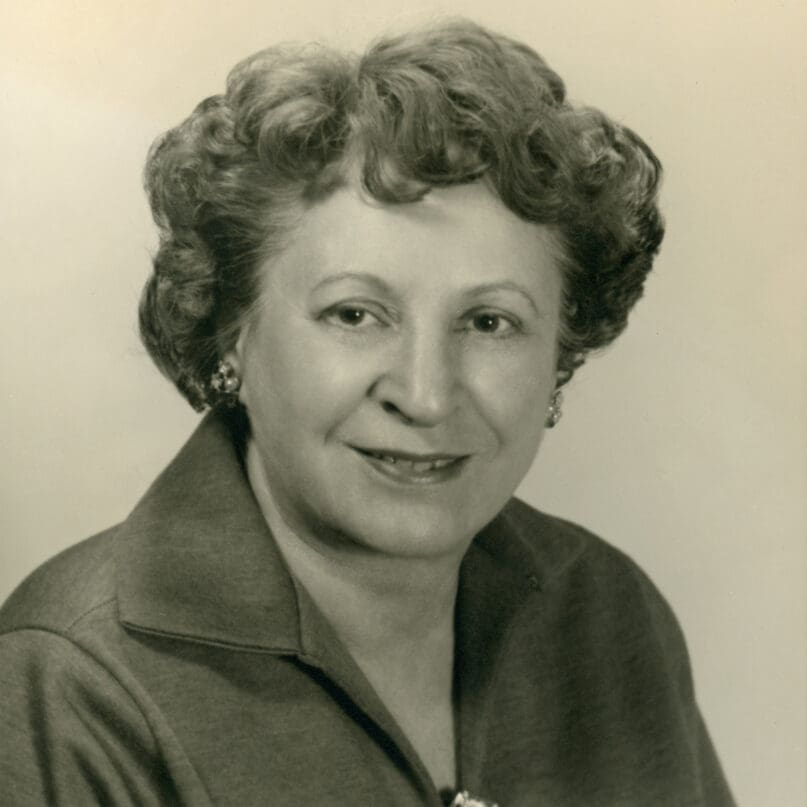
As described above, Ann found out her son Jerry was retarded when he was 9 months old. She knew one other mother who had a retarded child during this period of Jerry’s life. When Jerry was about four she met yet another mother with a retarded child, Mrs. Hunink, whose child was “mongoloid.” Ann discovered that there were no services for her son, she visited schools and didn’t like what she saw. Jerry was not eligible for CRMD classes until age 7, if he met the criteria when he turned that age. Ann describes her position at that time,
“From the time Jerry was small I had been writing letters, calling agencies, writing newspapers, radio stations, anyone I could think of, hoping somewhere someone would remember that these children needed something. Everyone answered, gave me encouragement, admitted they couldn’t help and sympathized. I wanted help in finding other parents of retarded children. I wanted help in starting a school which we needed and which we couldn’t get. I was turned down by everyone… I also made many telephone calls. I just went through the phone book. These agencies found out there was a problem because I brought it to their attention.” [this shows many of the characteristics of the Parents’ Movement– tenacity, energy, need to make public and government aware of the MR issue]
Ann tried to send Jerry to a school in Connecticut when he was 4 but it did not work out. He missed his family too much and returned home after a few days. At the end of 1947, Ann found an in-home teacher for Jerry, Mr. Stanley Levin, who was to play a role in the early development of AHRC. About this time Ann made her first positive contact with the Bureau for Children with Retarded Mental Development (BCRMD) in the Board of Education, a Mr. Chris de Prospo. He tried to help Ann and the other parents she knew by connecting them with other parents of retarded children.
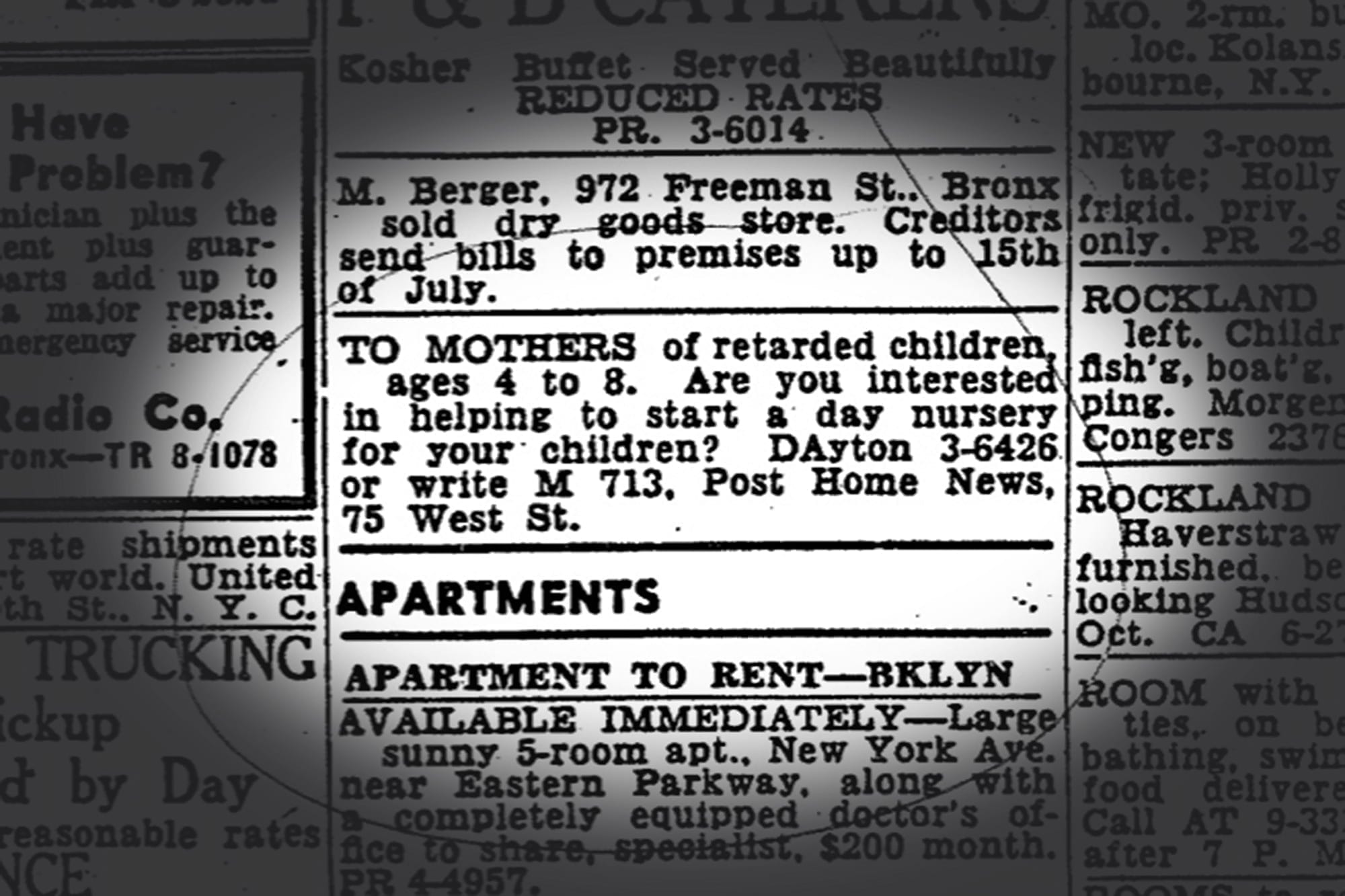
In the summer of 1948, when Jerry was not yet five, Ann decided to place an ad in the newspaper. In her words. “I felt it couldn’t hurt.” She had actually been mentioned in the paper before this, in a column by Dorothy Norman in the New York Post, and also on radio, on WMCA on a program called “Something Ought to Be Done” sponsored by Sachs Furniture. The program was aired on Sunday afternoon in the summer and Ann did not get any responses.
“I got impatient and decided to put the ad in the Post right away. It appeared July 7, 8, and 9, 1948…It read something like this: “To parents of Retarded Children 4 to 8, Are You Interested in Helping to Start a Nursery School for Your Children?, contact …etc.” I met the following parents from that ad- Pearl and Julie Schwartz, Rebecca Noble, Margaret Reiss, Rose Hurwitz and Mrs. Kanner…and of course Mrs. Lifschitz, Mrs. Hunink and myself. So we were nine people immediately.”
1948 NY Post ad posted by Ann Greenberg
At this time the parents, mostly mothers with fathers playing ancillary roles, began to do “a lot of running around…looking for other parents. A meeting was held. One of the members of the original group was unable to care for her son and had been forced to place him in Wassaic. Three new parents who had children in Wassaic joined them at that next meeting, but they never became active in the formation of AHRC.
Nothing happened for the next several months. The next break came when one of Ann’s letters to the National Council for Jewish Women had eventually been directed to a Mrs. Ann Glatzer, a teacher at the Child Development Clinic in Brooklyn and associate of the then famous psychologist Dr. Helen Thompson. The parents visited Mrs. Glatzer in her home, and she volunteered to teach children in her home, which never came to pass. But what was important about the contact was that Mrs. Glatzer connected Ann’s group with other parents she knew, adding significantly to their number. It was at this point that Ann decided to tell Mr. Levin, her son’s in-home teacher, what she and her friends were trying to do. Levin was extremely supportive and urged them to continue on and to form a parent group. He was the person who told Ann about the Welfare League for Retarded Children, the parent group for children who had been placed at Letchworth Village. The Welfare League was an older organization but its concerns were different than those of Ann and her friends, whose children were “community children.” It is interesting that Ann notes to herself, in 1950, that her perception of the Welfare League’s parents as requiring something different was “…not entirely right but I did not know it at the time.” [end note 3]
They held a meeting in the Fall of 1948 that Mr. Levin attended and at that meeting a formal decision to start a parents group was made.
It was also resolved that ads would be placed in newspapers to find more parents. They set a next meeting date of December 10, in Mrs. Noble’s home. Then six or seven of the parents recommended by Glatzer contacted Ann. An ad placed in the Post yielded ten more names. By December 10, Ann had a list of twenty parents and Mr. Levin invited additional parents. They all showed up. Ann wrote, “We filled up her living room and some of us volunteered to be officers and we had an organization on the way.” Ann then wrote the Post again, this time telling them of the history and of having formed a parents’ organization. At the same time Mrs. Noble wrote to Joseph Kahn, a reporter who had done a story about “our forgotten children.” Her letter was answered by him and he wanted to meet the parents. An interview was conducted at Mrs. Noble’s home to which Ann had come specifically armed with documentation of the lack of services for their children, thereby transforming a simple human-interest story into something more.
She wrote, “We had a very interesting interview with him and he took all my letters back to his office with him so that he could write up a proper story, and he did just that.” This “wonderful story” appeared in the Post on December 20th. That evening the parents happened to gather at Minnie Schaeffer’s house, planning their first big meeting and how to publicize it as much as possible. The story that Kahn wrote listed Mrs. Noble’s telephone as the contact number. That turned out to be a lucky happenstance since on the evening of December 20 Mrs. Noble was ill and had been unable to attend the parents meeting. “…She [Mrs. Noble] spent the whole evening getting telephone calls from people who had read his story and then I really had a lot of names,” said Ann, who called the interview and subsequent article by Joseph Kahn “a very lucky break” and “our biggest jump.”
Two other parents joined them that evening of December 20, Ida Rappaport and Ann Millstein. These parents had children in classes for children with retarded mental development (CRMD classes) at the time and they were later to split from AHRC to form the Association for Children with Retarded Mental Development (ACRMD), an organization of parents of children who were eligible for CRMD classes and considered “educable.”
At the December 20th meeting it was decided to have the big meeting on January 14, 1949. Through Minnie Schaeffer, who took her son for therapy at the National Hospital for Speech Disorders, it was arranged that the parents could use the Hospital’s auditorium.
“As you can see everything went very fast. I wrote to all the newspapers and several of them did put into the paper that parents of retarded children were planning a meeting in the National Hospital for Speech Disorders on Friday, January 14, and they all came. The auditorium was filled. People were standing in the hall. [a list of about 200 names of attendees is available]. Those of us who had spoken up to become officers ran the meeting. We gave out cards asking people to sign up. We told them everything we could. We set dues at $5. Many people paid right there. That helped get letterhead with my name as the office and my address to contact, and that’s how we started…Incidentally, Jerry [Weingold] and the Hechts came to that meeting also. They were invited by Margaret Rosenberg who had met Jerry at Camp Arlen one day. She wrote me a letter telling me that she knew of a great guy who could help us and his name was Joseph T. Weingold. I sent him an invitation to the January meeting and he was there and he joined also.”
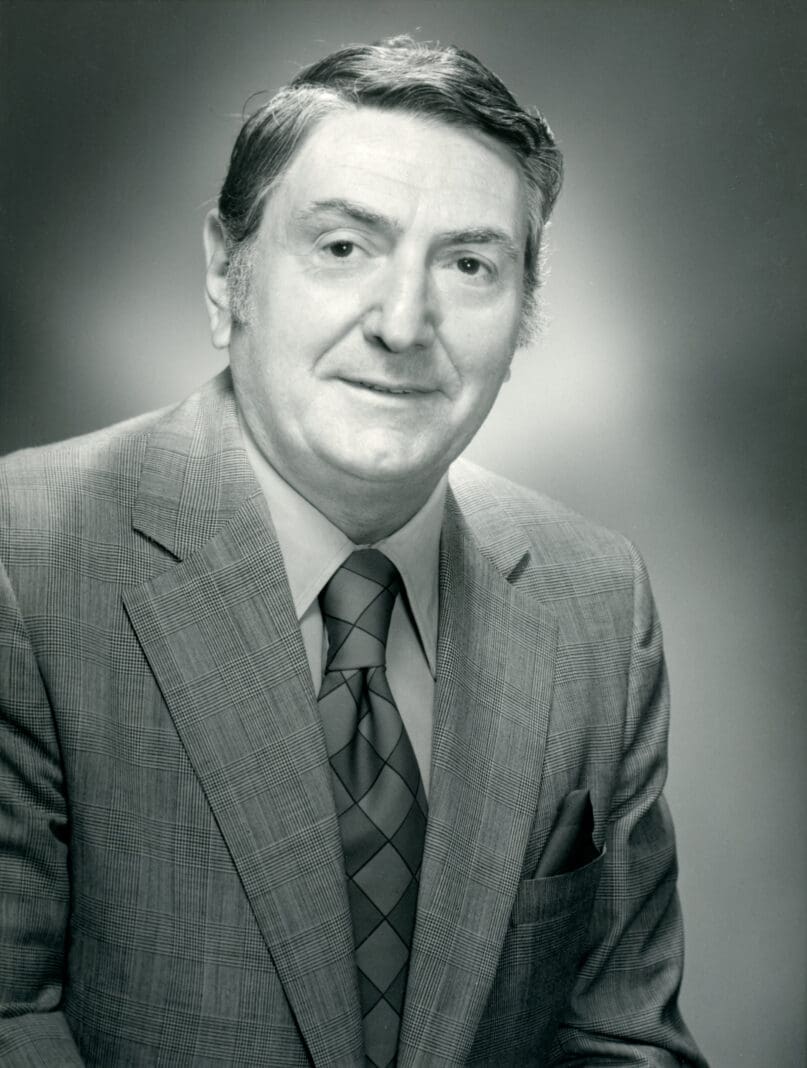
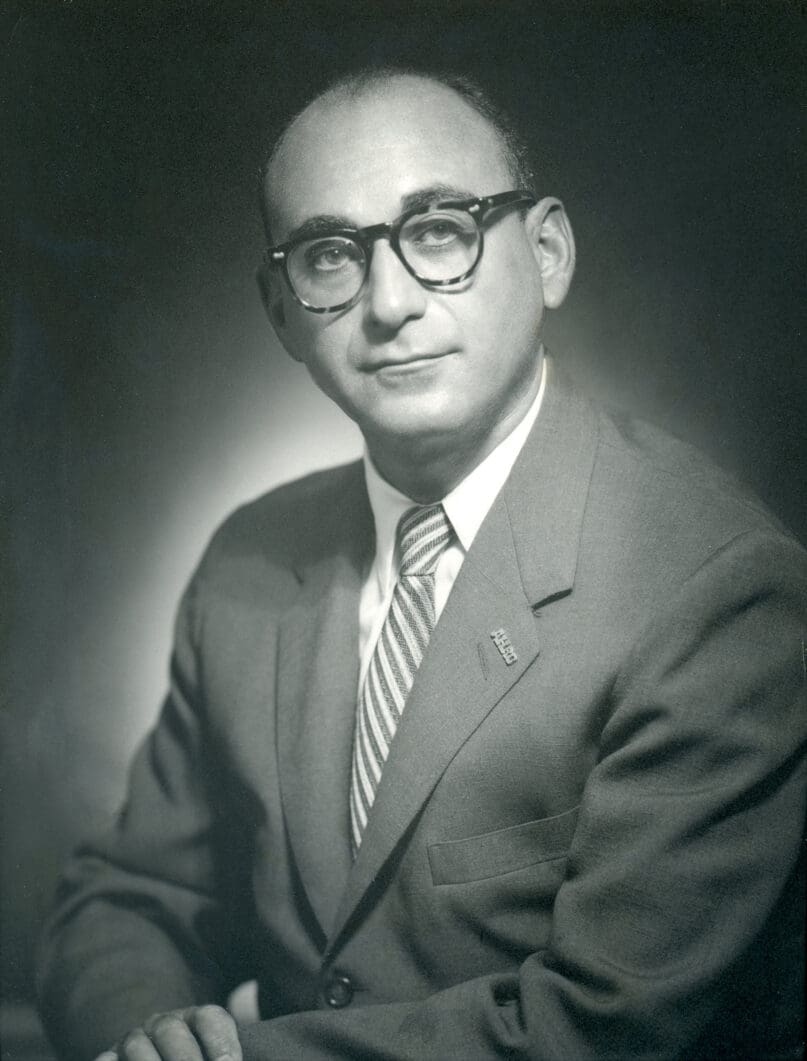
The group incorporated formally on January 19,1949 and held its first elections. The first non-elected President, Julie Schwartz, had to leave town for employment reasons, and Jerry Weingold was elected the first President of AHRC, with Nat Feder, the person to whom Ann addressed her 1950 historical account, as first Vice-President. When it was later decided that AHRC needed an Executive Director, the job was given to Jerry Weingold and Feder became President.
Nathan Feder, President of AHRC New York City’s Board of Directors, serving from 1950 to 1951.Joseph T. Weingold, President of AHRC New York City’s Board of Directors, serving from 1949 to 1950.
Several of the interviews I conducted, alluded to a power struggle between several members of the initial group of parents. As Jerry Weingold wrote in 1950, the very nature of parent groups is heterogeneous in every sense of that term. This was both a strength, in terms of the talents and skills brought to the group, and weakness, in terms of the problems inherent in melding different perspectives into one group. So, at the very inception of AHRC some differences may have surfaced. It was interesting that all persons involved who I interviewed mentioned this, but did not want to discuss it in detail and preferred to ‘let sleeping dogs lie.’
Ann concludes her 1950 account with the following paragraph.
“As you can see upon reading this, everything led to everything else. Everyone helped. Everyone tried but as Jerry used to say, “the time was just ripe!” It was after the war and we were all interested citizens. Incidentally, strangely enough many parents who joined us later and became very active all had children older than mine. Where were they all that time? Nobody knows. Nobody did anything. The time just came to do something and we did it.”
What perhaps is missing but assumed in this 1950 account, surfaced in my 1998 interview with Ann, I include it in the epigram to this chapter. I had asked her whether the parents ever talked about the War when they got together? Her answer was somewhat sharp, “Our conversation was only about retarded children.” The parents of these early years were committed to improving things for their children in an almost fanatical way. Jack Gorelick, a currently retired AHRC professional of many decades, recalls the post World War II period in a recent interview.
“Part of my thesis is that the success of the parents movement has to do with the events of World War II. You know if you look at who was involved…You know almost every father, although fathers tended to be somewhat less involved, was a veteran. And you have these things that happened during the War. You have the Holocaust, people away for a long time in the service. And when the GI’s came out, they were not going to take shit from anybody.” (with emphasis).
The parents who formed AHRC in 1949 were committed to their mission in a passionate way.
Jack Gorelick is probably exactly right in his analysis, that post-World War II America was such a society that a parents’ movement could take form. Jack called the parents’ movement “a ground swell…a popular movement…it’s almost like spontaneous combustion. The time comes, and it’s going to happen.” Many of the parents interviewed had the same sentiments, accounting for the title to this chapter and monograph, “And now let’s build a better world,” a quote from Ann Greenberg in her 1998 interview. Founding parents, certainly the active parents, lived, breathed and ate mental retardation. They would have meetings over supper and cook in the homes where they gathered. They became a kind of extended family, and a committed family. In these early years many interviewees recalled the “warmth and committedness” that characterized their relationships.
Jack Gorelick and I also discussed the high preponderance of names of Jewish origin on the list of 200 persons who attended the January 14 meeting. In fact over the years many have thought of AHRC as a primarily Jewish organization. At the beginning this concentration of Jews can be explained by the fact that there were many Jews in New York at that time, that many of those Jews had socialist and even communist philosophies and tended to be politically outspoken union people. These factors may have played a role in the initial response to the advertisement for the January 14 meeting and in AHRC’s early growth. But it is also true that AHRC quickly grew into an organization whose members’ ethnic and religious identification reflected the diversity of New York City, even though its reputation as a ‘Jewish organization’ continued in some circles, and may have played a role in its development.
A final note on the bottom of the page of Ann’s memo to Feder typed with a different typewriter, as if an afterthought and with a scrawled signature, “Ann Greenberg,” dated simply, “1950.” It reads, “Nat, you asked for the story and this is it. It is a good idea because years from now, nobody will remember.”