Chapter 5
Growing Up in the 1950s and 1960s
“A civilization is measured by the kindness and justice of its treatment of the
helpless.”– Pearl S. Buck, 1950
If the 1940’s mark the birth of AHRC, then the 1950’s and 1960’s represents its childhood and adolescence. The organization’s growth participated in the general changes with respect to people with disabilities at this time, both within the United States and internationally.
It was during the late 1950’s that Denmark adopted its laws on disability based upon the concept of normalization, that is, the idea that people with disabilities should be able to live a life as close to the normal as possible. At the same time Denmark and other Scandinavian countries began what was to be known in the United States as the Deinstitutionalization movement. The Danish parents, working closely with the Ministry of Social Services’ Neils Eric Bank-Mikkelsen, were instrumental in pushing these agendas before the public. Americans were beginning to be aware of these changes in the welfare states in Europe and were starting to bring some of these ideas into the United States, although their full expression and influence was not to be seen for another decade. Nevertheless, because of the efforts of parents themselves, international changes in human rights, and other economic and social factors, the 1950’s began to see a positive movement in the lives of persons with mental retardation.
The Middle and Late 1950’s
As stated in the previous chapter the parents in AHRC during the late fifties were occupied with issues related to public awareness and program development.
The enlisting of entertainment personalities for the cause was impressive. As described in Our Children’s Voice, even by 1953 such names as Morey Amsterdam, Kitty Kelley, Milton Berle, Sarah Vaughn, Jack Barry, Walter Abel, Pearl Buck, and Jan Murray had already been involved in AHRC fundraising. There had been several coast-to-coast broadcasts on NBC’s show “It’s A Problem” and Alex Russotto, then President, had appeared on Barbara Wells’ television program. Bobby Breen was also doing “his punchy pitches” (i.e., fundraising appeals) on radio. AHRC experienced fundraising success and increased public awareness of their children’s situation through these and other efforts. Public education by other organizations for children with other disabilities also began to take on more public importance at this time, and enjoyed increased media exposure.
AHRC and parent groups of that era were part of a more general awakening to the need for public education on issues related to children’s disabilities through the media.
About this time, the organized media itself began playing a role. In 1956, Sam Cook Diggs produced “The Wassaic Story,” that was telecast on CBS-TV’s “Eye on New York,” and later on CBS-TV’s network, coast to coast. It won the Albert Lasker Award for TV reporting on medical/public health issues. In his address to AHRC’s Annual Dinner at which he was given an award, he pledged broadcasters “wholehearted support to the fight– to solve the problems of mental retardation.” A year later, in March of 1957, Westinghouse Studio One televised Abbey Mann’s “A Child Is Waiting” on CBS network television, the first dramatic show on network TV to deal with the problem of mental retardation. This program had a great impact on public awareness at that time. It was praised by reviewers in the New York Times and elsewhere. AHRC presented an Award of Achievement to its producer, Herbert Brodkin, “for the intelligent and sensitive way the problem of mental retardation was presented to the American people. [end note 9]
Towards the end of the 1950’s there was an expansion of legislative appropriations to human services on the state and federal level, and some of AHRC’s involvement in legislative efforts were documented in the previous chapter. The trends in appropriations to this sector must have been obvious to AHRC in 1956, as their 7th Annual Dinner Awards to John Fogarty and Earl Brydges indicate. Twelve hundred persons were in attendance. Fogarty was the Congressman who, as Chairman of the House Appropriations Subcommittee on Labor, Health, Education and Welfare, was credited by AHRC for “outstanding contributions to the cause of mental retardation through courage in pioneering a broad program on a national level.” Our Children’s Voice (June-July, 1956). He created the first Congressional level panel on the topic and generally increased the appropriations to Health from $ 3.5 to 135 million in the ten years of his tenure as Subcommittee Chair. He also was credited with appropriating the first federal research grant in mental retardation, $750,000 in 1955. Brydges, as will be remembered from the previous chapter, was a State Senator who was Chairman of the Joint Legislative Committee on Mental Retardation and of the Senate Committee on Public Education. At the Dinner he was praised by the Association for “leadership to obtain services for the mentally retarded and help them achieve the dignity of individuals and citizens.” Through the lobbying efforts of the parents associations on the national, state and local level, legislation and appropriations to help persons with mental retardation was slowly on the increase.
In accordance with the general direction of its long-range plan, AHRC participated in a moderate expansion of programs throughout the 1950’s and 1960’s.
In 1953 AHRC opened its first workshop. Jerry Weingold was instrumental in pushing for vocational programs, including regular employment, and worked closely with Mary Switzer in Washington, D.C. on a national level demonstration program that was coordinated through her office. This was to mark the entry of AHRC into the employment sector, which was to become a major part of its program development efforts. Also in 1953, the Association opened its first experimental nursery for preschool children. Along with the parent education classes and clinics begun in 1950, the pilot classes for ‘trainables’ begun in 1951, [end note 10] and the social groups that were instituted in 1952 (the same year as the formation of the New York State Association for Retarded Children (NYSARC) with seven chapters), by the end of 1953 several of the basic elements of the long-range plan were being demonstrated.
The ensuing years saw the expansion of all services. The waiting list for clinics was 2500 by 1954, indicating the extreme degree of the need. Camp programs were expanded, even Camp Poynelle, where “the retarded and the normal share camp activities,” were in place by 1954. In 1955, New York State issued a legislative declaration that “the responsibility for the education and training of retarded children rests upon the State and not solely on the parents.”
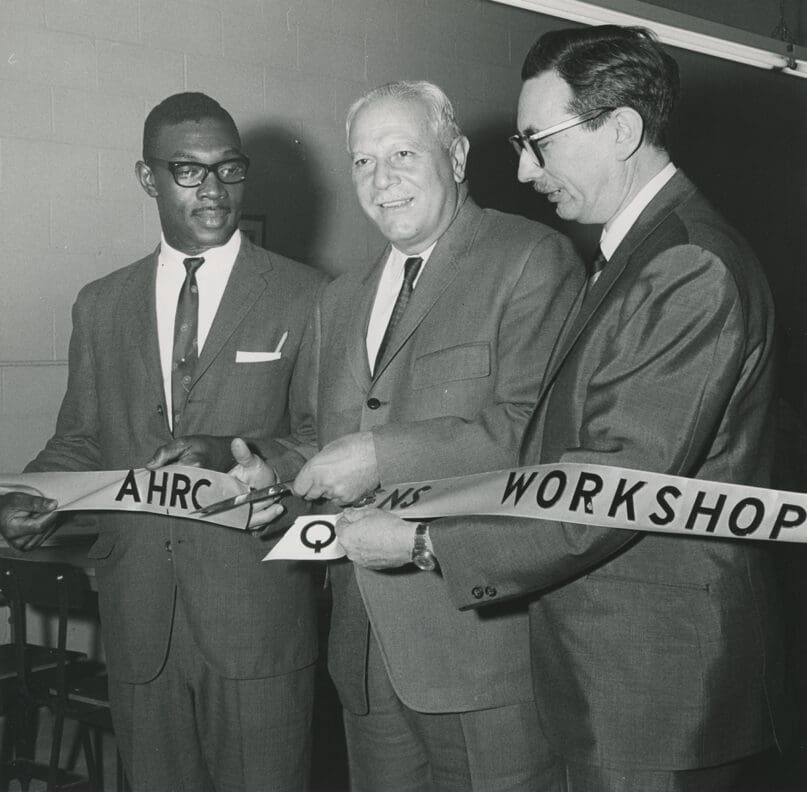
That same year AHRC received a grant under the Vocational Rehabilitation Act of 1954, further expanding their sheltered workshops. In 1956 there was a push to put into place recreation and social programs, such as after school programs, social programs for teenagers, and scouting programs. In 1957, social worker Meyer Schreiber began to counsel parents as part of the Association’s parent education efforts. In 1957 Weingold proposed to the State that it build a Research Institute for Mental Retardation (an idea that later came to fruition with the opening of the New York State Institute for Basic Research in Mental Retardation on Staten Island). And to meet the needs of young adults who are unable to participate in the workshop program, an occupational day center at Daughters of Israel Day Center on East 5th Street, was established.
Thus in 1957, in a brochure titled, “Information on Services and Activities,” AHRC described six types of services and activities: clinics (The Morris J. Solomon Clinic for the Rehabilitation of Retarded Children at the Jewish Hospital in Brooklyn, the Theodora Clinic for Retarded Children at Flower and Fifth Avenue Hospital in Manhattan, and the Shield of David Institute for Retarded Children at the Shield of David Home, Bronx); schools (at P.S. 84 Brooklyn, P.S. 72 Queens and the Joshua School in the Bronx– for children ineligible for CRMD classes); training centers and sheltered workshops (a training center and sheltered workshop on East 27th Street, combining the earlier Brooklyn and Manhattan workshops); recreation services including: scouting programs for the young (cub and scout programs in Brooklyn, Queens and Manhattan), social groups for adolescents and adults (serving at this time about “122 young men and women [in nine groups] throughout the city),” general services (parent education programs, information and referral service, consultation service, coordination services) and what is in the brochure referred to as “The AHRC” (i.e., the opportunity for parents to meet other parents and to serve on committees in AHRC to help better their children’s lives).
One problem of AHRC and other parent groups at this time was that of competition and lack of cooperation. This was true in other states, but probably none so acutely as New York.
The battling between the institutional-based groups and AHRC was recognized nationally. [end note 11] In Samuel Diggs’ 1957 address to AHRC, he made the following remarks,
“At the risk of being considered out of order on this night when you have so graciously paid me such a wonderful honor, I am going to fuss at you just a bit. What I am going to say, and I say this with sincere interest in the problem…I say with affection and great sympathy.
“I am going to fuss at you because I feel so keenly the urgent need for united action– we cannot afford the luxury of a divided house.
“There is too much squabbling between various interests and between groups engaged in this fight to bring about better conditions for the mentally retarded and their families.”
Diggs knew about the conflict between the institutional and community-based groups in New York through his involvement with NARC, which was notably concerned with the problem in the same way as Diggs appears to be in these remarks. He chose his words, carefully I imagine, given who must have been in the audience. Emotions ran very high about the issue of who ‘really’ represented the interests of mentally retarded persons in the State. When he was approached by NARC to reach a compromise with the institutional groups, Weingold was reported to say that “there was nothing to talk about.” To the mutual benefit of all involved, these differences were eventually resolved by NYSARC at the state level, but not without a long battle. By 1957, the Sunshine League of Monroe, New York, one of the institutional-based groups, is listed as one of NYSARC’s twenty-six chapters. But the Welfare League, the oldest parent group in the State, continued to fight AHRC about the issue of membership in NARC, among other things. It was also true that AHRC locked horns with the NARC on several substantive issues during this period and later, and that for a time AHRC dropped out of the national.[end note 12]
During the 1950’s much effort was unfortunately wasted by parent groups vying with one another for recognition and resources. To the detriment of their own interests sometimes they did not present a united front regarding their children’s needs.
Despite this and other difficulties, AHRC was fortunate to close out the decade with three significant victories, all of which occurred in 1959.
First was the passage on the federal level of social security legislation benefiting persons with retardation. AHRC and other parent groups around the nation had strongly pushed for this legislation in Washington. Then, in August of that year, the New York State Department of Mental Hygiene announced the formation of the Office of Mental Retardation that was to coordinate and develop all services for the mentally retarded in the State. It was placed under the directorship of Dr. Arthur W. Pense and charged with responsibility for both institutional care and the development of community programs. The creation of a state level agency to perform these functions had been urged by AHRC since its inception, ten years earlier. Finally, the American Association on Mental Deficiency, through its classification manual, officially changed its nomenclature from the language of “mental deficiency” to that of “mental retardation,” and added a social component to its clinical assessment. This, as was described above, was a particularly proud moment for the founding parents.
At the close of the 1950’s AHRC was a relatively small human services organization that had been remarkably successful in promoting the welfare of persons with mental retardation and their families through public education and legislation. It operated a few programs primarily for purposes of demonstrating their feasibility and to meet need where governmental support was absent or inadequate. By this time AHRC’s focus had clearly become the “trainable” population, as a result both of the splitting off of the ACRMD, and because the need was far greater for those families with children for whom no legislative mandate or services existed. In 1957, for example, in a pamphlet titled, “Every Child Shall Have The Right,” the Association says quite explicitly under the topic heading “With Whom We Are Concerned” that “We are concerned with the ‘trainable.’ ” Some interviewees said that this focus also had to do with the developmental status of several of the founders children, and there may be some truth to this assertion.
Probably the most important thing it had achieved in its first ten years was to establish parent groups as the leaders of the field of mental retardation. AHRC created “professional lag.” Dr. Samuel Kirk, in the Annual Report, New York State Joint Legislative Committee on Mental Retardation, is quoted as saying in March of 1960,
“The public has gone so fast in their demands on what should be done with the mentally retarded in all areas– medical, social, educational and otherwise– that today we find not so much a cultural lag, but really a professional lag.” (p.63)
The public, namely parents, had begun to lead the professionals in the field. Yet, for reasons largely unrelated to its own efforts and own successes in this decade, AHRC was about to make even greater strides forward in its maturation.
The 1960’s: Becoming Kosher
Jack Gorelick, who was deeply involved in AHRC politics of this era, said that “the most critical event was Kennedy’s election as President.” This occurrence was to change the course of mental retardation in the United States.
It is not uncommon that the particular happenstance and human concerns of Presidents and Prime Ministers somehow appear on the social agendas of their societies. Most persons know that John F. Kennedy’s family included a sister with mental retardation. The Joseph P. Kennedy, Jr. Foundation, the first private foundation in our country exclusively concerned with mental retardation, and the Special Olympics, today a worldwide sports association for people with mental retardation, are two conspicuous results of the efforts of the Kennedy family in this arena. But most people today do not appreciate the incredible effect that the Kennedy’s going public with the story of their sister had on societal attitudes toward people with mental retardation.
Gorelick states,
“All of a sudden it was like…John F. Kennedy is my bosom companion, you know? And that is what happened. It was the aura of respectability that came bang like that! And that was a key event. That was a most important event psychologically for people in the field. We were kosher. Before we were traife, now we were suddenly kosher…After 1960 if you are a real American you are going to support mental retardation.”
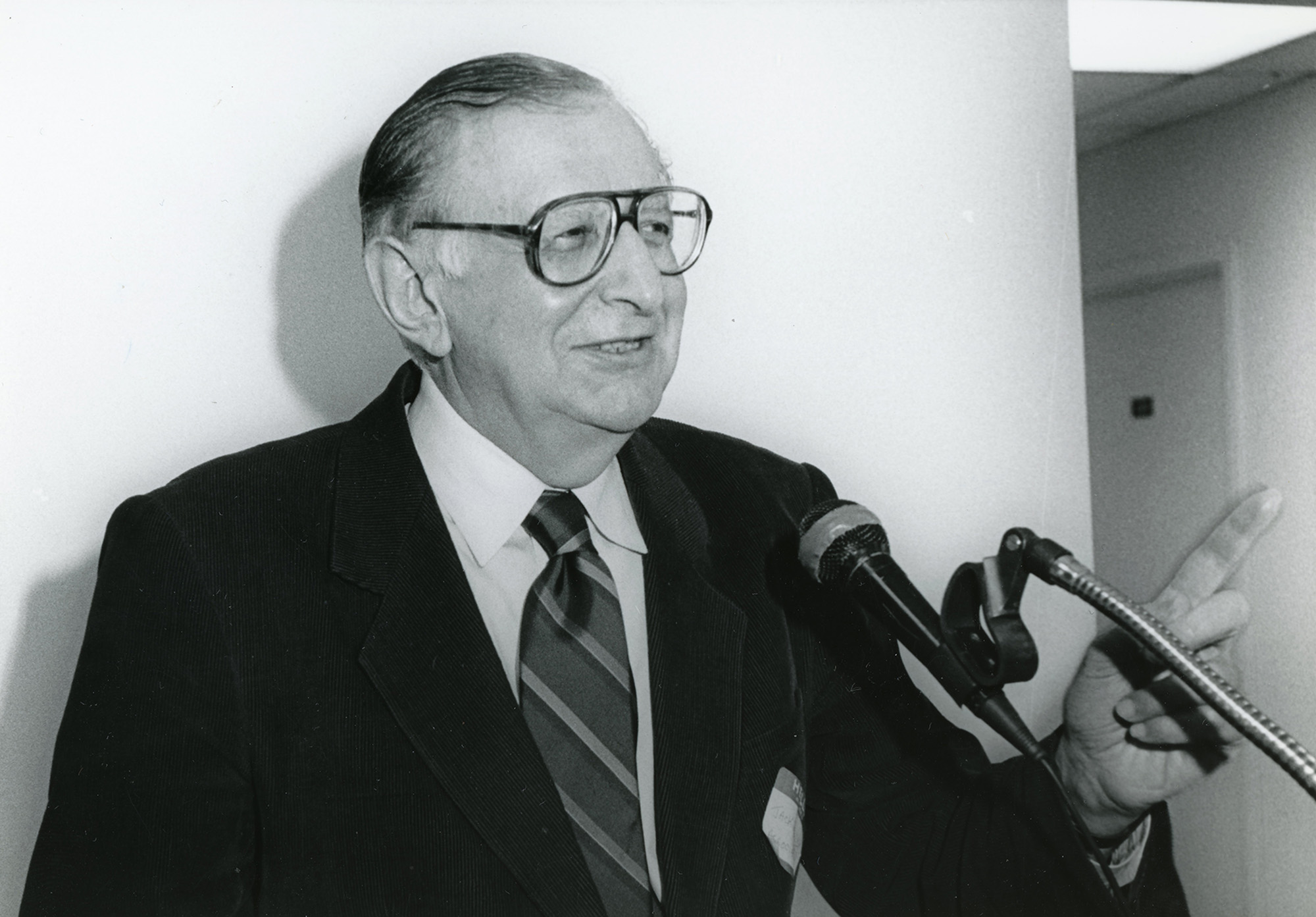
After his election to the Presidency, Kennedy not only spoke openly about his mentally retarded sister, but Eunice, one of the other Kennedy sisters, wrote eloquently in magazines about the family’s situation. The effect was electrifying, not only in the United States but also abroad where, for example, De Gaulle announced that he had a daughter with retardation. Mental retardation had become a “shi-shi” social cause, and not something to hide away in the closet.
But the Kennedy’s did not at all limit their efforts to private foundations and public education. President Kennedy created the President’s Panel on Mental Retardation (PPMR) in 1961 (later becoming the President’s Committee on Mental Retardation (PCMR)). His administration spearheaded legislation and policy that was to have a profound effect on the future development of the field. Some examples are, the recommendation of PPMR to reduce the census in residential institutions, the passage of the Mental Retardation Facilities and Community Mental Health Centers Construction Act in 1963 (beginning the flow of federal dollars into institutions), and the amendments to the Social Security Act in 1965 (establishing the Medicaid and Medicare programs). These were all accomplishments of, or as a result of, the initiatives of the Kennedy administration. The passage of the amendments to the Social Security Act in 1967 that created Intermediate Care Facilities for the Mentally Retarded (ICF/MRs), while not a direct result of the Kennedy administration, was a direct reflection of the different policy and legislation that his presidency brought to this area. With the Kennedys in the White House, the federal government had clearly ‘entered the mental retardation business.’
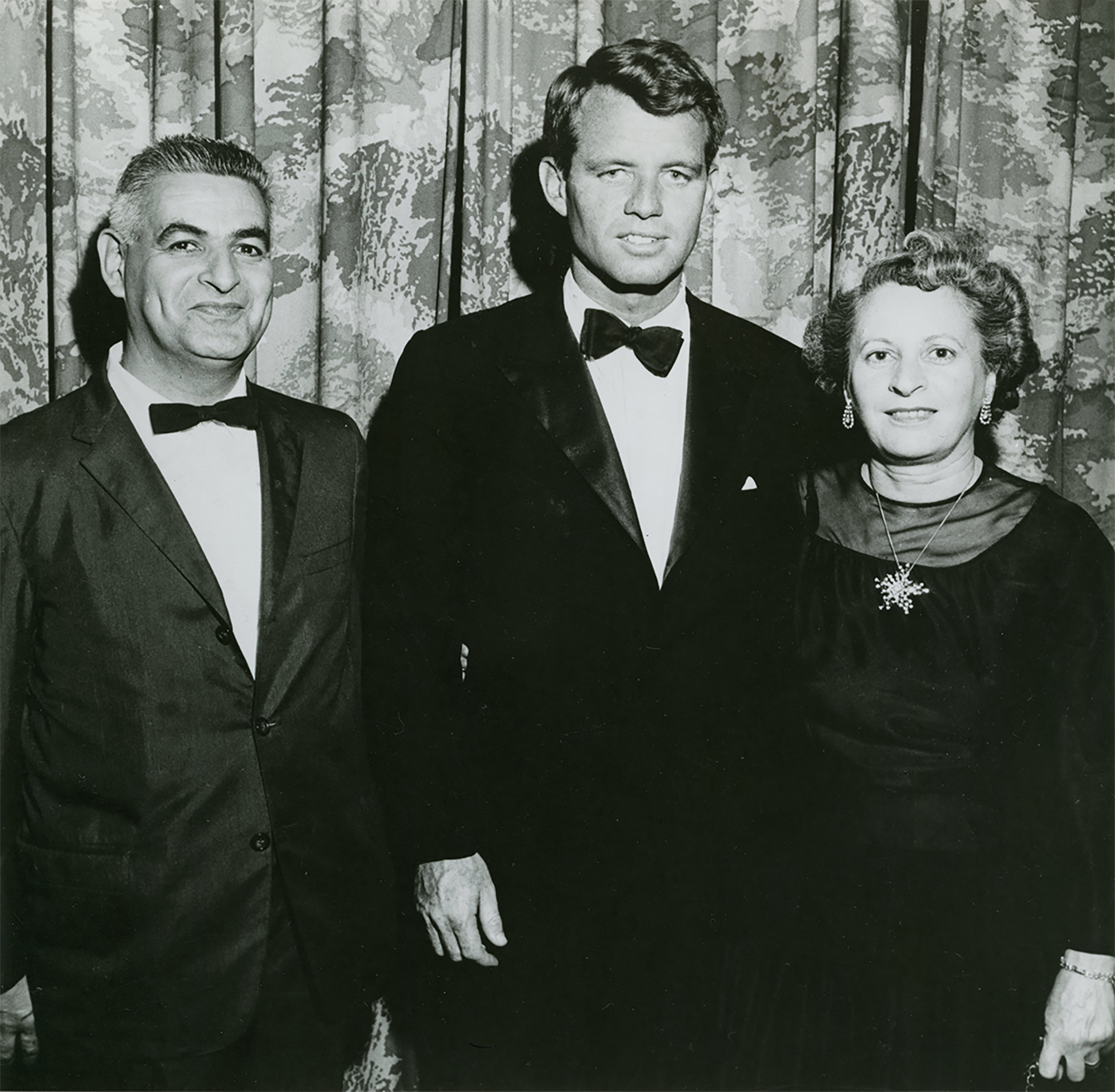
Within New York State, the US Attorney General, Robert Kennedy, was involved in mental retardation during the 1960’s largely as an advocate and as a critic of institutional conditions. He delivered many speeches in the mid-1960’s, for example his October 17, 1964 address on the opening of the Institute on Mental Retardation at Queens College, in which he called for an overall attack on the problems of mental retardation, and a dedication of social resources to help these persons. He also was quite outspoken in his criticisms of the State when it came to the conditions of institutions, and was one of the first national political figures to speak so condemningly of them. In a New York Times article of September 10, 1965, he is quoted as saying conditions at Willowbrook were like “a snake pit.” While it is not clear from his remarks that Kennedy wanted institutions closed in the state, it is the case that his remarks helped fuel the Deinstitutionalization movement that began in the early 1970’s.
With more progressive attitudes and liberal policies, AHRC grew during the 1960’s.
In addition to the programs it already operated, in 1965 it expanded through opening an adult treatment center in Far Rockaway. A year later, a satellite workshop opened in Woodside, Queens. And a year after that AHRC opened a Saturday pre-school program in Queens, an Occupational Training Center in Brooklyn, and, with the Children’s Aid Society, a preschool in Manhattan. At the end of the decade it operated a total of 16 programs, making it a moderately sized social service agency.
Entering the decade of the 1970’s, AHRC had been in existence for just more than twenty years. It had already witnessed, and indeed helped bring about, a change in attitudes towards people with mental retardation and had participated in the development of new services for them and their families.