Deinstitutionalization and Community Integration: The 1970s and 1980s
“Once the foundation was conceptualized and laid, and you had a strong organization, a lot of volunteers, a very active membership group, then it was really easy.”
– Jack Gorelick about AHRC in the late 1960’s.
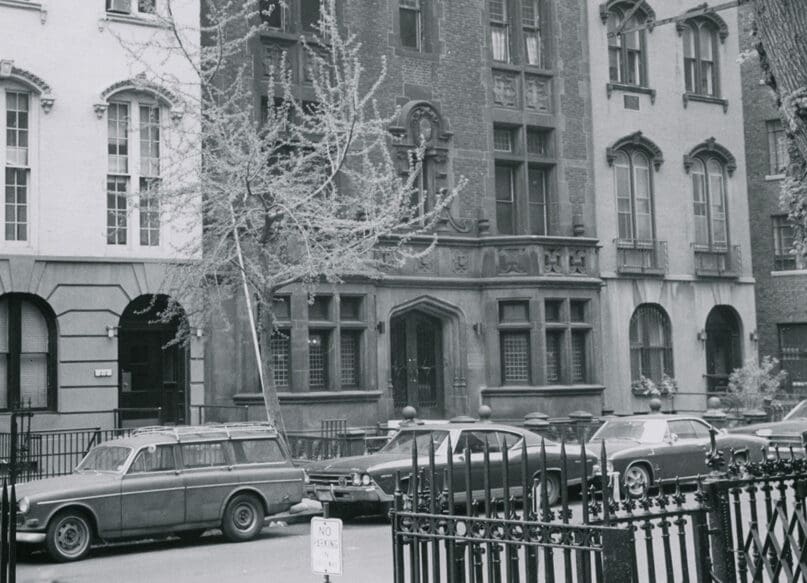
The 1970’s and 1980’s were tremendous periods of growth for AHRC. The decade began with the opening of Fineson House in 1970, AHRC’s first residential service. It was funded by the Office of Mental Retardation as one of several experimental community “hostels” for adults with mental retardation as an alternative to institutionalization.
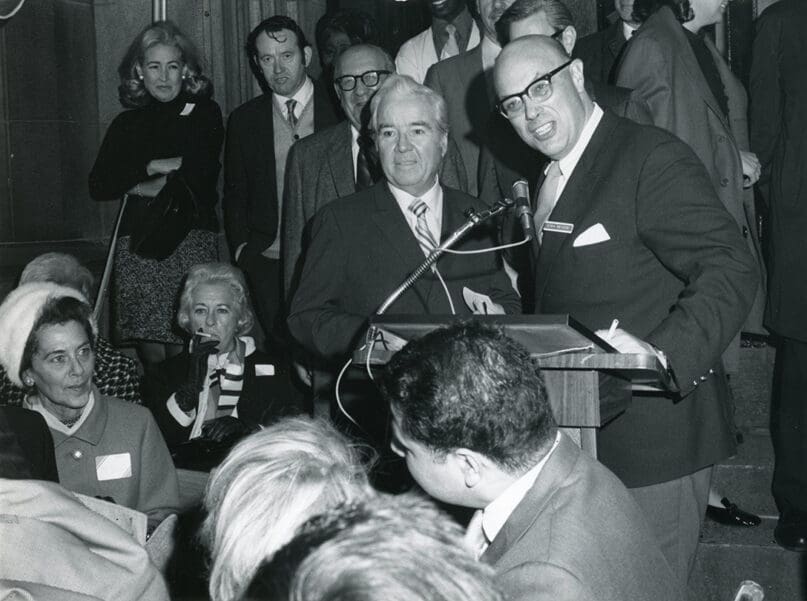
Fineson House, 1970sWilliam Conklin with Stanely Meyeters at the Fineson House dedication 1970
The development of community residential alternatives was one of the last elements of the long-range plan to be put into place. And while AHRC was clearly committed to such places for the children of member parents before the Willowbrook exposé, as will be seen, it was in fact the massive ideological, institutional and legislative changes that took place in the 1970’s that were responsible for the incredible growth of the agency during this period.
The basis of a strong organization was already in place before these events occurred, but the historical conditions of this period provided an ideal growth medium for AHRC.
On a national level, for many reasons not the least of which was the parents’ group movement, we began to see legal and legislative changes that furthered the interests of children and adults with retardation in a way never before seen in our society. The beginning of the decade saw the Pennsylvania Association for Retarded Children vs. Commonwealth of Pennsylvania, which in 1971 established the right to education for children with disabilities, and the right to due process in educational decisions. The next year Wyatt vs. Stickney in Alabama established the constitutional right to treatment and in the least restrictive environment. In 1972 Amendments to the Social Security Act created Supplemental Security Income to provide financial subsidy to persons in need, including those with “developmental disabilities.” [end note 13] In 1975 three major pieces of legislation were passed, indicating how mobilized around issues of disability the society had become. In that year President Nixon signed an executive order reaffirming the nation’s commitment to returning one-third of the two hundred thousand persons with mental retardation living in institutions to the community.
Congress passed Public Law 94-142, the Education for all Handicapped Children Act, mandating free, appropriate public education in the least restrictive alternative for children with developmental disabilities.
Congress also passed the Developmental Disabilities Assistance and Bill of Rights Act, which established the legal definition of the term, created Protection and Advocacy systems, developmental disability planning councils, and university affiliated facilities in each state. Then, in 1977, in Pennsylvania Association for Retarded Children vs. Pennhurst State School and Hospital, the courts established the guarantee of equal protection under the 14th amendment to the Constitution as applying to people living in mental retardation facilities. These legal and legislative developments for persons with physical disabilities (such as Section 504 of the Rehabilitation Act of 1973) created the legal substructure under which problems related to the overall welfare of persons with disabilities in America could be finally addressed.
The effect on the educational system was to place the burden of education of children with disabilities squarely upon the shoulder of the State, and this, of course was what AHRC had wanted from its outset.
This meant that AHRC no longer had to be in the business of running classes, that the Board of Education now would have to provide for the educational needs of all school-age children with mental retardation. Although it took twenty-five years since the formation of AHRC for this to become official educational policy, these legislative changes must be seen as at least partially a result of AHRC’s perseverance and patience.
AHRC continues to this day to operate classes for children not provided with education by the Board of Education. It also employs an educational advocate since the mid-1970’s to ensure that those attending Board of Education programs receive the education to which they are entitled.
At the same time the publication of The Principles of Normalization by Wolf Wolfensberger in 1972 had created an ideology within which both parents and professionals came to evaluate their programs and efforts. Normalization was a Scandinavian paradigm that entailed a commitment to creating normal conditions of life for people with mental retardation. Its popularity had been mounting during the 1960’s through the public speeches of well-known advocates such as Bengt Nirje in Sweden and Neils Eric Bank-Mikkelsen in Denmark (the originator of the approach). It was described, popularized and operationalized in the United States and Canada by Wolfensberger, and by the end of the 1970’s was The philosophy of our field. It was known to administrators, professionals, direct care staff, and even to some of the residents at the State Hospital where I worked in the 1970’s. Normalization articulated a new value base for services, one that enhanced the community inclusion of persons with disabling conditions.
Deinstitutionalization in the 1970’s
As mentioned in the title of this chapter, the other major movement in the beginning of the 1970’s was Deinstitutionalization. Beginning in Scandinavia in the 1950’s, this movement was already underway in the 1960’s in the United States. We have already heard about Robert Kennedy’s efforts to expose institutional conditions in the mid 1960’s. In addition, parents associated with the various institution-based groups demonstrated for betterment and/or closure of state schools (although before the television exposé of Rivera they described themselves as “yelling into the air”). Further, there had been many newspaper exposés replete with photos. For example, on Staten Island, Jane Curtin, a reporter for the Staten Island Advance, wrote several articles exposing the conditions at Willowbrook in the early 1970’s. [end note 14]
But it was the television exposure of conditions at Willowbrook State School by then ABC television reporter Geraldo Rivera that served as the historical catalyst for the closing of institutions in New York and around the nation.
The horrifying images of large numbers of children naked, restrained, lying in their own feces, congregated together without supervision, were to create a public and political uproar that previous coverage failed to do. On the 25th anniversary television special by Rivera of the Willowbrook exposé, when a parent who had picketed Willowbrook before Rivera arrived said to him that he was responsible for finally gaining the public’s attention, Rivera responded by saying, “It was the pictures.” This was probably a correct reflection.
Once Rivera televised the series of special programs exposing the conditions at Willowbrook, it was not long thereafter that a coalition of organizations filed suit against the State for violation of the civil rights of their children. NYSARC was one of the groups that sued the then Governor, Hugh Carey. In fairness to Carey who had just been elected, a less sympathetic former-Governor Malcom Wilson had allowed conditions at Willowbrook to seriously degenerate under his administration. As will be remembered from above, Willowbrook State School was taken back from the Department of the Army in 1948 and officially opened in 1952. It had been originally designed to house about 2,000 people with mental retardation. By the end of the 1960’s, Willowbrook housed over 6,000 persons and had become the largest institution in the world for people with mental retardation. This expansion was largely due to the use of the facility as a dumping ground for the New York City Department of Social Services. All kinds of people ended up at Willowbrook. There were normal persons with delinquent backgrounds, abandoned children without any disability, children and adults with disabilities but not mental retardation, children and adults with multiple disabilities and profound mental retardation, and all other levels and types of disabilities. There was a building devoted entirely to babies, which by the time of the exposé housed hundreds of infants. One worker of that era recalls visiting the baby building which was “completely silent,” the infants having learned quickly the futility of crying.
The overcrowded conditions at Willowbrook were exacerbated in the1960’s by budgetary cuts. These cuts created dangerous and critically substandard conditions at the facility. Many buildings would have four or five staff to care for up to a hundred residents. The average feeding time for children who could not feed themselves was about three minutes. This was done by shoveling mashed up food into the children’s mouths, leading to the most common form of death for children at Willowbrook, aspiration pneumonia. Bernard Carabello, an eighteen year resident of the facility who had cerebral palsy but not mental retardation, recalled having to drink out of the toilet bowls during the summers, because the kitchens were closed to the residents. He recalls having the “hell beaten out of me” when he transgressed the rules or when a staff member did not like him. There were many cases of death at Willowbrook reported in the newspaper, often deaths caused by other inmates. Less known at the time were the facts of resident life such as forced sexuality, institutional homosexuality, and institutional peonage. Though technically legal, residents of Willowbrook were medically experimented upon, often with permission that by today’s ethical standards would not be considered in any way adequate.
Willowbrook for many was a concentration camp-like existence whose revelation to the society by Rivera could have called for nothing less than its closure. This is precisely what occurred. Governor Carey decided that it was not necessary for those suing the State to actually go through the process in court. He was willing to close Willowbrook without suit and filed a no lo contender movement in court. This led to what was called “The Consent Decree” in which the State of New York agreed to close Willowbrook under the supervision of a court appointed Board of Monitors. The Consent Decree established a legal precedence for closure that was employed in similar suits around the country. It also helped establish a process by which Deinstitutionalization could be achieved. This included the development of community services and residential options for individuals that had been formerly housed at Willowbrook. Finally, the exposé and Consent Decree established an unfriendly political climate for institutions, which have been under attack since.
The option of institutionalization was no longer considered good medical advice and this also added to the need for the development of community services.
Of course these developments created ideal conditions for the creation of community programs and residences by agencies in the New York area. It was this era that saw the expansion of many community agencies around the City. The State was committed to closing at least Willowbrook, and possibly other institutions. There was a national policy of depopulation and the legal basis for establishing community services for the population. The State had no choice but to follow along with appropriations and the stage was set for massive expansion of agencies.
Judy DeIasi, the current Associate Executive Director of AHRC remembers that period during her 1998 interview.
“…it was easy to grow. Michael was a good Executive Director but anybody could grow, anybody. You know the money was there. You want to open a one hundred and fifty person day treatment center?…Open it…So the agencies grew…People…knew an opportunity.”
While this characterization of the situation was true for many agencies that seized opportunity and embarked in virtually unplanned growth, AHRC maintained a different position following Willowbrook. First it led the way in the formation of an Interagency Council (IAC) reconstituted more along the lines of a trade association. The IAC became an effective planning and action network and through it agencies were able to control the growth of community services for adults with mental retardation. For example, through the IAC Goldfarb advanced the position that all new programs should include equal mixes of ‘class clients’ and adults from the community who are on the waiting list, a recommendation that was to have positive repercussions in the lives of adults with mental retardation in New York City.
Secondly, AHRC did not immediately get involved with Willowbrook ‘class clients,’ as some other agencies did. It was a conscious decision not to develop programs until community services were at least planned and to some degree developed, and until AHRC created management structures to accommodate such growth. Thus while AHRC was considered the lead agency in the area, it was not quick to develop services for the Willowbrook clients, to some degree angering the State agency by its seeming unwillingness to proceed. But Goldfarb remarks, “…in the end it was good for us.”
Goldfarb promoted the agency to grow only after the necessary political and management groundwork had been put into place.
But as DeIasi’s remarks indicate, these were the “Golden Years” of the mental retardation movement. It is thus remarkable, but not entirely surprising, that the agency experienced a more than ten fold growth in staff size from two hundred employees in 1975 when Goldfarb became Executive Director, to two thousand five hundred employees in 1998. When Goldfarb came to AHRC its budget was approximately two million dollars. Today, it is over ninety-five million. When the residents at the 30th Street supported-apartment complex were asked about the changes in AHRC over the years, the first thing that came to their minds and that they strongly expressed was, “Now they are very big…They grew over the years!” (Gilda Lindenblatt)
In 1971 AHRC began to operate its own camp, Camp Catskill.
A group of men at Camp Catskill
In 1972 it opened another Occupation Day Center in Willamsburg to provide programs for children attending the Brooklyn State School.
In 1973 the Association opened the Bronx Adult Day Center on Mayflower Avenue.
In 1974, as a sign of the progressive educational policies described above, AHRC transferred 13 classes it had operated for children with severe and multiple disabilities to the Board of Education (actually leading to a reduction in program size but in an ethically desirable way).
In 1976 the Melvin Krauss Residence opened on East 5th Street in Manhattan.
That same year, Jack Gorelick opened a diagnostic and treatment clinic at the main office in Manhattan. The clinic, the first of its type to be headed by a non-medical director, provided diagnostic, medical, psychological and counseling services, as well as being the entry point for referral, group work, recreation and camping.
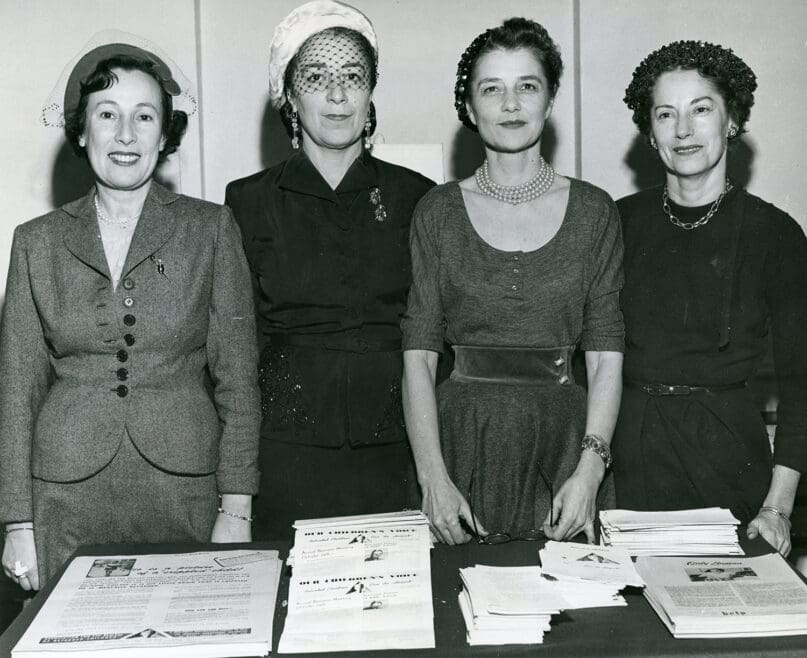
Four members of the Blue Feather Auxilliary standing in front of a table with pamphlets.
In 1977 with the efforts of AHRC’s Blue Feather Auxiliary, AHRC opened the Blue Feather Early Childhood Program at P.S. 312 in Brooklyn, aimed at providing early intervention and education to children ages two to five.
In 1978, the agency opened the Linden Boulevard Adult Day Center in Brooklyn, and the Plato Malozemoff House in a brownstone off Washington Square in Manhattan. Finishing in a flurry of program development at the end of the decade, AHRC opened five community residences and the House in the Country program in 1979. The new residences included: Greenberg House in the Bronx, Linden Boulevard Residence in Brooklyn, Petersen House and Building #53 on Staten Island, and Striar House in College Point, Queens. This same level of expansion was to characterize the 1980’s, as we shall shortly see.
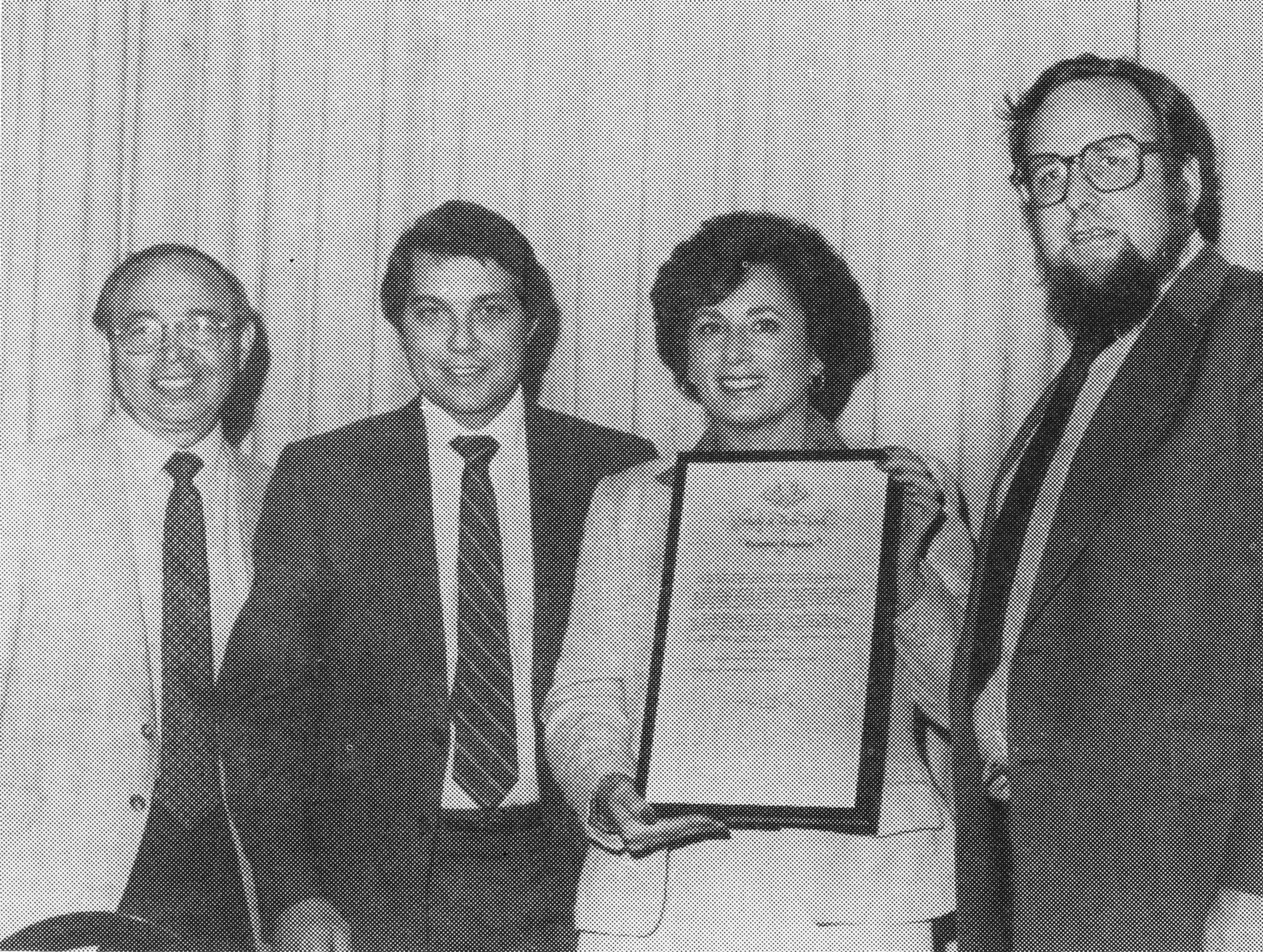
AHRC president Irene Platt holding a NYS citation awarded to the organization during the annual meeting for sponsoring the film, “Best Boy.” Commissioner James Introne (second, left) of the NYC Office of Mental Retardation and Developmental Disabilities, made the presentation on behalf of Governor Carey. Looking on are Ben Weisenthal, meeting chairman, and AHRC executive director Michael Goldfarb. Source: AHRC Chronicle Fall 1980, Page 4
Before doing so it is interesting to note that AHRC had been involved with the production of the feature length documentary “Best Boy” at the end of the 1970’s. This film concerns the residential placement of a man, Philly, who had lived with his mother well into his 50’s. It poignantly portrayed the dependency of the mother on her son, and the ambivalence both felt at separation, but also the feeling of freedom experienced once the separation was achieved. The film was made by Ira Wohl, the cousin of “Best Boy” and was awarded the Academy Award for full-length documentary in 1980. The agency thus continued its early commitment to public education through media. [end note 15]
AHRC was one of the New York agencies to lead the way in the late 1970’s in the establishment of self-advocacy groups within its programs.
Self-advocacy is a self-help, civil rights style movement in which persons with mental retardation speak out on their own behalf. The movement began in Sweden in the 1960’s when parents asked their children what they wanted to see in the supports and services given to them. It took form in the United States through the “People First” movement that began in Oregon in the beginning of the 1970’s. People who had been living at Fairview Hospital decided that they were going to organize a group that would represent their interests at conferences and in government. Someone in that group used the term ‘people first’ and it caught on. People First chapters began opening all over the country in the 1970’s. AHRC and other New York providers, while wary at first, ultimately did support the organization of these groups within their programs and residences. Self-advocacy was a risky experiment at first, but today is regarded as a necessary option for people with mental retardation who want to organize around their own interests.
Yet another development of the late seventies was the arrival of I. William Stone to the agency as a member of the Board.
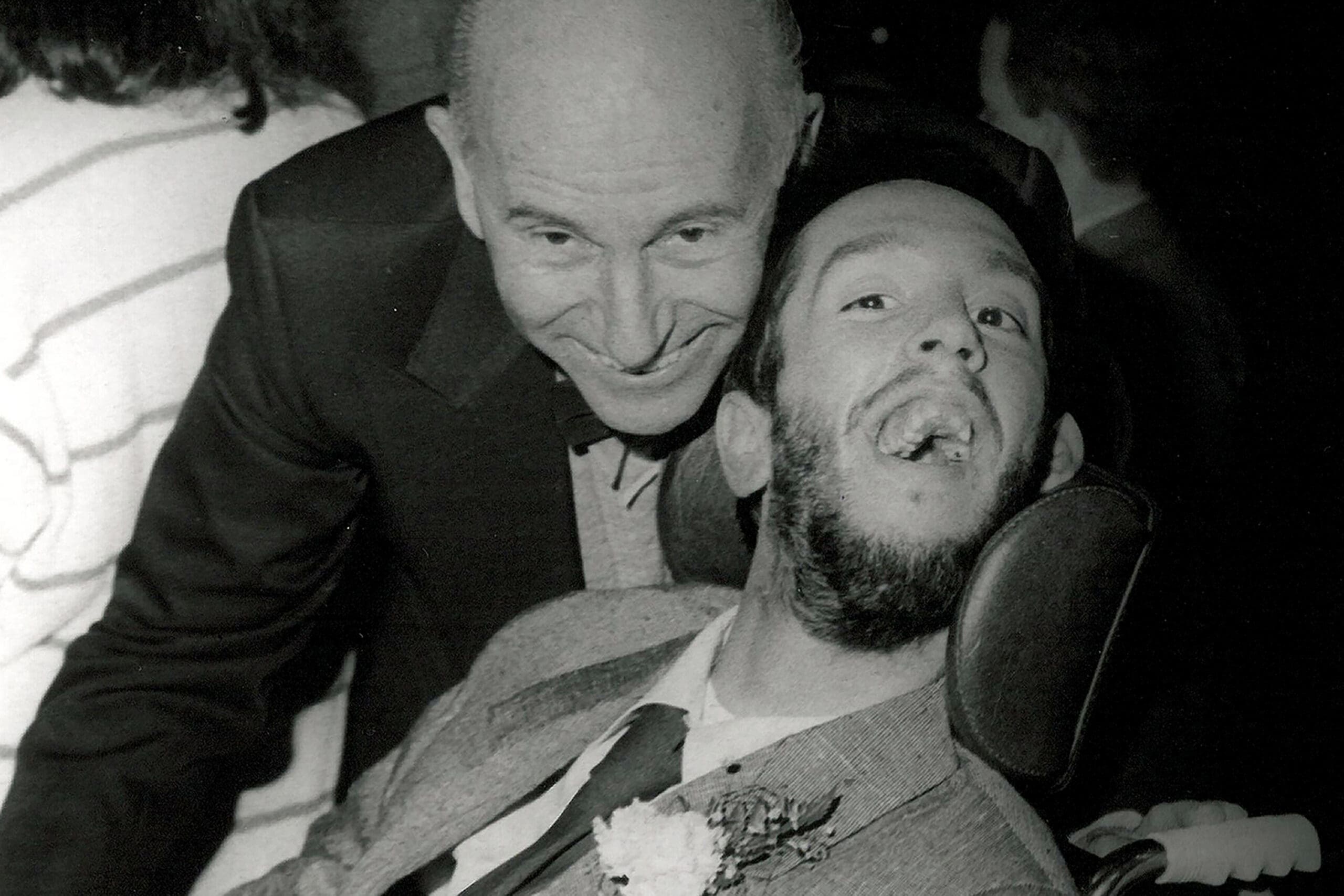
I. William Stone with his son, Howie
Stone is the father of Howie, his son who was born with multiple disabilities including cerebral palsy and mental retardation. Howie, as he put it in his interview, “always fell through the cracks.” When he would inquire about agencies serving persons with physical disabilities he was told to go to one serving mental disabilities. When he would inquire at those agencies he was told to go to agencies serving people with physical disabilities.
Stone’s long-term involvement with the agency was to ultimately sensitize it to the needs of persons with mental retardation and physical disability, and particularly to the importance of addressing issues of accessibility in residential and adult services.
He commented in his interview,
“I am willing to take some credit for making AHRC aware of the needs of the multiply handicapped, particularly those who are physically handicapped. There is no question that I fought for that. Agovino [the first fully accessible residence operated by AHRC-DG] would never have come about if I had not kept fighting. It took seven years and it could have easily been too much trouble and set aside. Yes, what I tried to do was make the other members of the Board aware of the fact that if we opened a new residence it had to be wheelchair accessible. Definitely, I pushed this since the day I came on. When I first came on there was no focus at all on the physically disabled mentally retarded.” [end note 16]
The presence of Stone on the Board and his emphasis on serving persons with physical as well as mental disabilities was important to AHRC. He helped to put the agency a position of being a couple of decades ahead of its competitors in terms of issues of accessibility.
The changing status of AHRC during the 1970’s can be summarized through the following metaphor. When AHRC began it was the big fish in a very, very small pond. By the end of the 1970’s it had become a big fish in a big pond. Many other agencies “knew an opportunity” and had taken advantage to greatly enlarge their mental retardation programs. Some of these, such as the Young Adult Institute (YAI), an agency formerly headed by David Bond but taken over by Joel and Phillip Levy during the 1970’s, was particularly aggressive in public relations and agency name promotion. In fact, all agencies became more sensitive to these matters as their budgets and expertise permitted. But certainly by the end of the decade AHRC was no longer the only premiere agency in the city. While it was, and probably always will be regarded as the “dowager queen” (Goldfarb interview) of agencies for people with mental retardation, it had taken its place among other significant large service organizations. Its role as the leading agency in the field, however, remained fairly constant, and is still recognized today.
The 1980’s: The Era of Community Integration
The progressive changes in policy and legislation continued throughout the 1980’s. This decade had been named “Decade of the Disabled” by the United Nations. Internationally the UN sponsored events and conferences during the decade that culminated in the passage of the United Nations Standard Rules for Equalization of Opportunities for Persons With Disabilities (Resolution 48/96 of the General Assembly of the United Nations, passed December 20, 1993). In Europe, high levels of professional activities and meetings under the HELIOS I and HELIOS II programs moved both policy and program models forward during this period. The European Commission passed its own version of the Standard Rules in 1996.
Paralleling the increased global awareness of disability issues, in the United States, several changes in legislation came early in the 1980’s that profoundly effected the services for people with mental retardation. First was the amendment to the Social Security Act in 1981 that came to be known as ‘the Katie Beckett Waiver.’ This allowed children to receive care at home who otherwise would have previously needed institutionalization for eligibility for Medicaid. Then, the so-called “Medicaid waiver program,” part of the Federal Omnibus Reconciliation Act (OBRA) of 1981, created the possibility of diversion of Medicaid funds into small community settings.
Of course the most significant piece of legislation to come out of the 1980’s for persons with disabilities in the United States was the Americans with Disabilities Act (ADA).
While signed into law in 1990, the disability rights movement, including parent and other groups, participated in a decade long political process that resulted in the ADA. Similar in emphasis to the Standard Rules, ADA aims at ending overt discrimination and isolation of people with disabilities within the society. Its provisions, considered by many ‘radical’ when the bill was first passed, include regulations regarding accessibility in public transportation, public buildings, public media and communications, equal opportunity and reasonable accommodation in employment, and other provisions that, when fully implemented, would substantially enhance the quality of life for people with disabilities.
All these developments during the 1980’s were expressions of the liberal sentiment that were part of the Golden Era of mental retardation, when funds were available to those who saw an opportunity. While a conservative backlash against the expansion of social programs for needy persons was beginning to gain power, the decade was still one in which program growth was fiscally feasible for mental retardation agencies. Deinstitutionalization proceeded slowly. Persons coming out of institutions and those in the community who were adult and needed residential placement, were the human need upon which programs were built. Funds were still generally available to agencies opening up community-based programs.
In 1983, AHRC opened a residence for eight men and women with profound mental retardation and multiple disabilities, the Ozone Park Residence in Queens. In 1984 the Phyllis and Harold B. Jacobs House was opened in an Upper West Side brownstone. In 1985, a community residence was started in the Bronx, the Elena Agovino Residence. That same year the Blue Feather Minna D. Bober residence was opened in Brooklyn. Two additional summer programs were also added in 1985, one in the Pennsylvania Mountains (House in the Poconos) and one at the Jersey shore (House on the Seashore). The Harriman Lodge, a summer resort program for adults with mild mental retardation, opened in 1986 in the Catskills. HIRE (Helping Industry Hire Reliable Employees), a supported work project that involves job training and placement in competitive employment was initiated in 1986.
In 1987 AHRC began operation of the Paula & Anthony Fisher Adult Day Center on 10th Avenue in Manhattan. In 1988 the Agency expanded further by opening the Gruenstein Residence in Holliswood, Queens, and two supervised apartment programs in Brooklyn, thus moving into the currently popular program model relatively early. In the Bronx in 1988, AHRC began its Bronx Seniors in Action program, aimed at meeting the needs of elderly people with mental retardation. These new programs significantly expanded AHRC’s array of services.
By the end of the 1980’s it was a large agency, by any standard, with an annual budget of about thirty million dollars.
In 1985, AHRC began providing services and supports focusing around the issues of adult siblings of brothers and sisters with mental retardation and other developmental disabilities. The Sibling Program was one of the earliest attempts by a human service agency to deal with this group’s needs.
Jack Gorelick remembers,
“I started the sibling group…and you would also want to talk to Meyer Schreiber about this. He worked with many of the kids. We were one of the first in the country to work with these kids. And the parents would say, “What did they say?”…You know, the most difficult job I ever had was working with siblings. The anger…”
What the pioneering work of Schreiber and Gorelick revealed was that the complex emotional issues found in all families are even more complex, even more intense, when the family has a child with mental retardation. AHRC became a leader in establishing sibling support groups and supports. Dr. Edmund Haddad joined AHRC in this effort, and with Dr. Thomas Powell, the then Director of the University Affiliated Program in Connecticut and himself a sibling, established a national sibling network that still thrives today.
Before looking at AHRC in the 1990’s and the changes the agency underwent in its tremendous expansion, a last contribution of AHRC leadership in the 1980’s, particularly Goldfarb and Gorelick, should be described. They were considering ways to enhance staff quality in AHRC programs. AHRC, as other agencies in the City, faced a crisis in staffing at the direct-care level. The low pay of these jobs, relative to other forms of employment, created a virtual crisis in direct care staff quality in many agencies. Anyone with a high school diploma or GED could basically work for an agency serving persons with retardation. They needed no training. Staff turnover in New York City was alarmingly high, with some agencies reporting almost complete turnover within a year at the lowest staff positions. AHRC attempted to keep pace with the salaries of the State in part to address this problem. Even so, staff quality, not only at the direct care level but at all levels, became a preoccupying problem for AHRC in the 1980’s. The solution Gorelick and Goldfarb came up with was to have the higher education system in New York, particularly the Community and Senior Colleges of the City University of New York, train the needed workers and professionals. The idea of establishing a Fellowship program for workers was also part of their solution.
Goldfarb recalls,
“And so we designed this twenty years ago, the idea for fellowships was mine, the notion of using the university was his. And we put this together and marketed the thing for years and couldn’t get anybody to bite… We met with everyone and we still couldn’t get it moving…”
He then recalls sitting in a meeting with John Kennedy, Jr. in 1987.
“I said, ‘Wait a minute. I’ve got this idea you might be interested in. We’re working with CUNY on this institute to train workers in the field. What it really needs are Kennedy Fellows…He liked that and I went back to Jim Murphy and the Chancellor Joe Murphy…and I told them, we got Kennedy interested. The thing took off.”
The Foundation had given substantial seed monies to the cousins of the Kennedy family to use in matters related to disability. John Kennedy, Jr. had taken a particular interest in the quality of the direct care work force issue, and had become involved with the City University initiative. He took a direct interest in the formation of the initiative, attending planning meetings at the City University with Jeff Sacks, his adviser and friend who had initially introduced him to Gorelick and Goldfarb. The initiative took off partially because the Kennedy name had been leant to it, and partially because Kennedy invested in the Kennedy Fellows program, and also in supporting the salary of a staff person in the central CUNY office, Dr. Bill Ebenstein, to coordinate matters related to disability education, training and research. The eventual success of the Goldfarb-Gorelick solution to workforce education and quality issues was, as in the past, a particularly innovative contribution from AHRC to the field. The CUNY Consortium for Disability Studies, and the Kennedy Fellows Program, are two of the first examples of programs of this type in the country. Today it is a huge success involving hundreds of Kennedy Fellows all over the City.
Goldfarb recalls a recent meeting of the Kennedy Fellows that he attended.
“The first speaker was Jim Murphy. He talked about the fact that Jack Gorelick and I created the idea. He says, ‘Sit in front of the room’…which I don’t usually do. And then Kennedy gets up and talks about the visit to my office during which the idea was presented to him. And then Jeff Sacks gets up…he remembered. They all remembered little pieces. I was so touched just that they remembered.”
It is well that people should remember the contribution made by these men. Their perseverance over twenty years in promoting this idea and their eventual success in some ways reminds one of the efforts of the founding parents. Mike Goldfarb and Jack Gorelick should be proud of the role they played in creating this innovative training model. AHRC played a ground-breaking role in the modern worker training movement. [end note 17]
In the decade of the 1980’s, despite the fact that AHRC was no longer the only big fish in the pond, it continued its tradition of leadership in the field of mental retardation by establishing innovative programs such as the CUNY Consortium and the Sibling Network.