“An Idea Whose Time Has Come”: Joseph T. ‘Jerry’ Weingold and the First Years of AHRC
“As soon as I met him I realized he was somebody.”
– Ann Greenberg of Jerry Weingold
“It would seem that the pent up energies of many years propel us forward and we move with a motion and volition beyond our control.”
– Joseph T. Weingold, 1950
There is a debate in history that goes something like this,
“Do great men make history, or does history make great men?”
It has always seemed to me that both propositions were true, and this can be very clearly seen in the case of Joseph T. ‘Jerry’ Weingold and the parents’ movement.
He was the right man, at the right place, at the right time.
Elected first President of AHRC and its first Executive Director, he later became Executive Director of the New York State Association. In these capacities he helped establish and set the direction in the field of mental retardation for the next several decades.
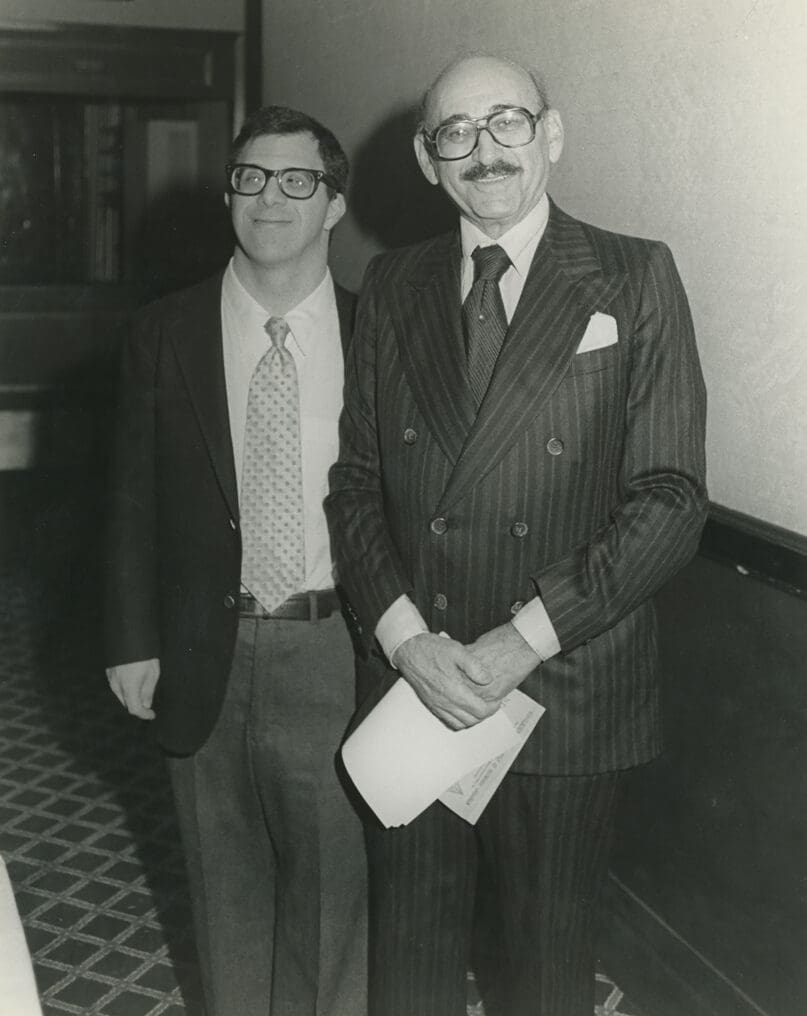
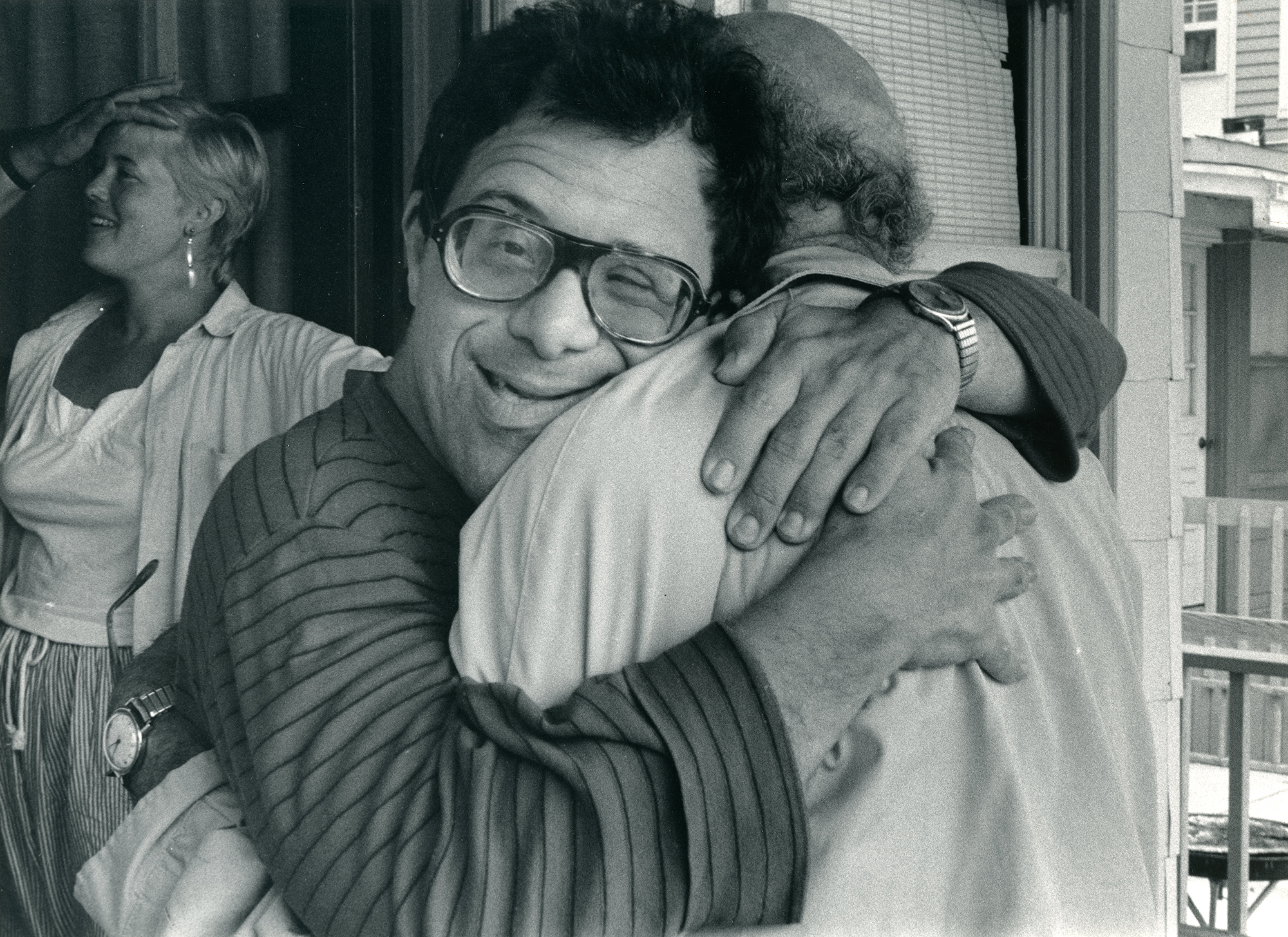
Virtually all the people I interviewed for this writing admired Jerry Weingold, even his critics. I have heard him described by a real variety of adjectives, depending upon to whom I was talking. Literally every interviewee acknowledged that Jerry Weingold was a brilliant man, effective politician and devoted parent to his son with Down syndrome, Johnny. Many felt that Weingold was one of the most influential figures in our country in both planning and instituting community-based care for persons with mental retardation.
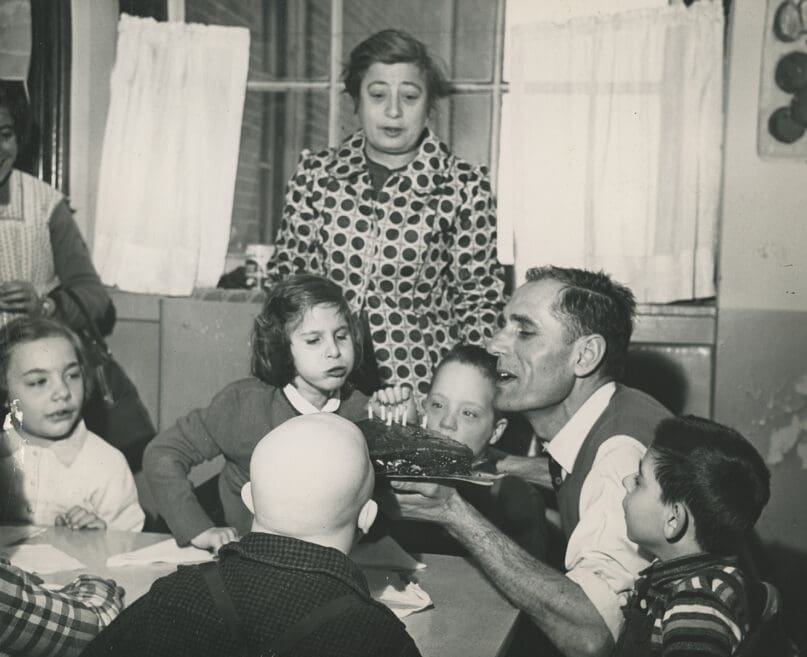
Jonathan and Jerry WeingoldJonathan and Jerry embrace
This section of writing will attempt to communicate a sense of the person Jerry Weingold was and to describe the blueprint for community services for people with mental retardation that he wrote in 1950. Under his leadership AHRC thrived as an organization, as the review of AHRC’s achievements in the first years of its existence will reveal.
Weingold the Man
The stories told about Jerry Weingold indicate that in many ways he was a romantic figure larger than life. One interviewee said, “Did you hear about Jerry Weingold being with MacArthur in Africa?” “No,” I told him, “I haven’t heard that one.” He then went on to relate how Weingold had been ineligible for military service because of a birth defect to his right hand (another thing I had not heard, apparently he shook hands with his left hand). But, I was told he had somehow used his lawyer connections to get assigned to MacArthur, and MacArthur wanted to “put him in charge of the French Fleet.”
Jerry Weingold was a lawyer, and he was a large and sometimes intimidating man. He had also been a Rhodes scholar at Oxford, England and a champion swimmer. I was also informed that he could be extremely gracious (when he wanted to be) and thoroughly entertaining, and that he was adored by women. Although I never met Jerry Weingold, arriving back in the state after he had passed away, I can accept almost all these claims people made about him. But as to the status of the French Fleet story, I am not sure. Perhaps this is what happens when you take on heroic dimensions to those around you, as Weingold did for many parents at that time, who often looked to him for inspiration.
We have already heard about how Jerry Weingold was made aware of AHRC and came to the January 14, 1949 meeting. When he became involved with AHRC he was a successful lawyer in the fur business with his father and brother.
As Ann’s epigram to this chapter indicates at the outset Weingold was a leader.
He so impressed the group of parents with his intelligence and organizational ability that they elected him President in February, 1949, through a write-in ballot, and made him Executive Director in March of 1950.
One founding parent said of Weingold,
“…And along came this idea that we needed an Executive Director and Jerry Weingold, if he were crafted by some genius could not have been more qualified. He was the most magnificent. I don’t think his equal will be found anywhere, partly because I suppose inner motivation, but mostly because of what was between his ears.”
While there was heated debate about whether any parent should be paid to work for the cause, Jerry was clearly the right choice for Executive Director, and when it became obvious to all in the beginning of the next year that one was needed, he was appointed.
Before examining Weingold’s 1950 formulation of his vision of services for children and adults with mental retardation in the State of New York, and the achievements of AHRC in the first years under his guidance, here are a few telling anecdotes about Jerry Weingold’s character and his early leadership of AHRC. Jerry Weingold was a hero of sorts to many of the parents at the time.
Gene Gramm had praise for Weingold in that he was,
” …a heroic mold for me because all my heroes had a sense of humor… Jerry’s sense of humor…was a kind of black comedy…ironic humor. Somebody once approached him, a woman, and said, ‘I don’t want to sound like this is a competition or anything Jerry, but I notice that the parents of Down syndrome children are invariably brighter or more intellectual…’ He benignly looked at her over his glasses and he said to her, ‘Well… better luck next time.’ “
Weingold’s sense of humor was renowned, an ironic sense of humor that complimented his intellectual nature. It was a humor that was respected and shared by many of the other active parents. But it was his overall commitment, intelligence, and leadership that made the parents admire him.
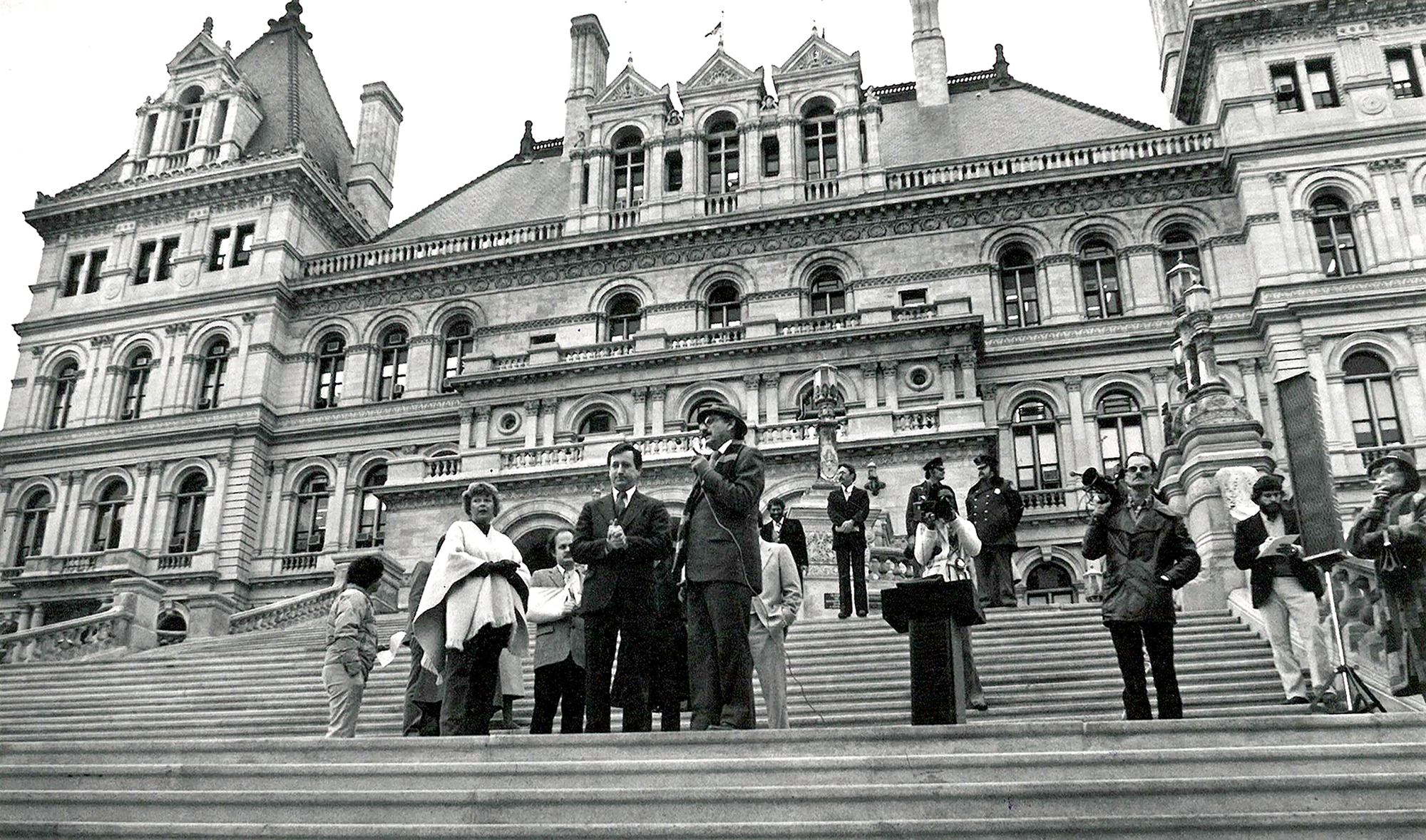
Jerry Weingold was also described by everyone as politically astute and sometimes even Machiavellian. In order to achieve what the parents needed to achieve, his “curmudgeon-like” personality proved extremely useful. The following occurred in the mid 1950’s when AHRC was pressing the state to start public school classes for children below the IQ of 50 and displays not only Weingold as political strategist, but also his relationship with the parents of AHRC. The Association was having trouble getting the Governor to support their position that there should be public education for these children.
“I remember going up to Albany one time when we were having problems…And Jerry asked some parents to agree to send their severely retarded sons and daughters up by bus. I think there were two busses, about sixty to eighty people. He asked the parents to agree to leave their kids there if we didn’t get anything from the Governor. And so we go up there and have our demonstration, and Jerry Weingold goes into the Governor’s office…He was there a while… I don’t know if the press covered this or not…But I do know that the idea was that if we don’t get what we want, we’re leaving the kids up there. You know…you take care of them. We can’t…we’ve had it up to our ears and that’s it. You take care of them. We’re going to leave. The parents agreed to do it. We were going to do that.
Joseph Weingold standing with others at a rally in Albany NY, June 1980.
“So Jerry goes in to see the Governor and the Governor is begging for more time, saying, ‘I’m doing what I am doing,’ and begging for more time. And Jerry Weingold said, ‘You know Mr. Governor,’ whatever he called him, ‘its always like this.’ Then he said, “You are going to find out what it is like to take care of them because I want you to know that we are going to leave these kids here. And you know what? Most of them are not toilet trained and they are going to shit all over your floor.’ And the Governor said to Jerry, ‘Oh no Jerry, you wouldn’t do that.’ To which Weingold replied, “We’re doing it, we’re leaving, good-bye,’ and he headed for the door. And on his way out the Governor was yelling, ‘Jerry, Jerry, come back, come back.’ (pauses with a smile on his face) And that is the way he got things done. Jerry was a direct action kind of guy…This is my proud possession [indicating a small statue that he is holding]. That says, ‘Sue the bastards.’ That was his…on his desk.”
This anecdote is a revealing one. It shows what Jack calls a style of “direct action.” Weingold, throughout his career was able to achieve, by a combination of political smarts and direct action, incredible changes in services for children with mental retardation. He knew what had to be done to achieve the parents’ goals and was willing to do it. But the anecdote reveals indirectly another thing about Jerry Weingold, how much he was trusted by the parents at AHRC. How many parents of children with severe disabilities would trust an Executive Director of a parents association enough to walk out on his command and leave their children in the care of the Governor?
Weingold developed extraordinary contacts in State government, and also to some degree with national and international governments and professional associations. He also had good ties to the American Association on Mental Deficiency, particularly to Lloyd Yespen who had recently been president of that organization (1947-48) and who Weingold cites in the first edition of “Our Children’s Voice” (March 18, 1949) as “…one of the most eminent authorities on mental deficiency…and one of the most stalwart champions of our cause.” Through such contacts Weingold was very aware of trends and developments in the field. He knew the value of networking and public exposure, as will be seen when we review the achievements of AHRC in its first year. And, it is true that happenstance also played somewhat of a role in his success. His association with Bill Conklin, State Senator from Bay Ridge, Brooklyn, was well known.
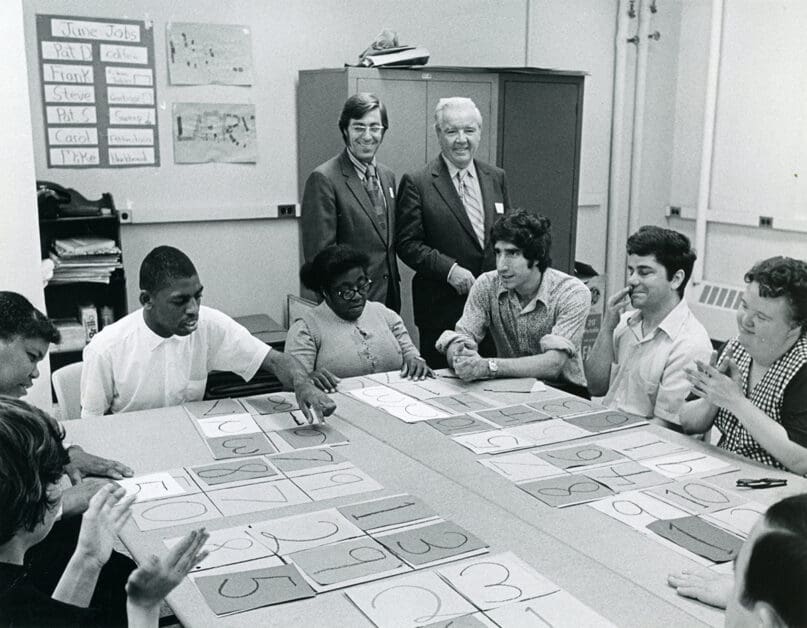
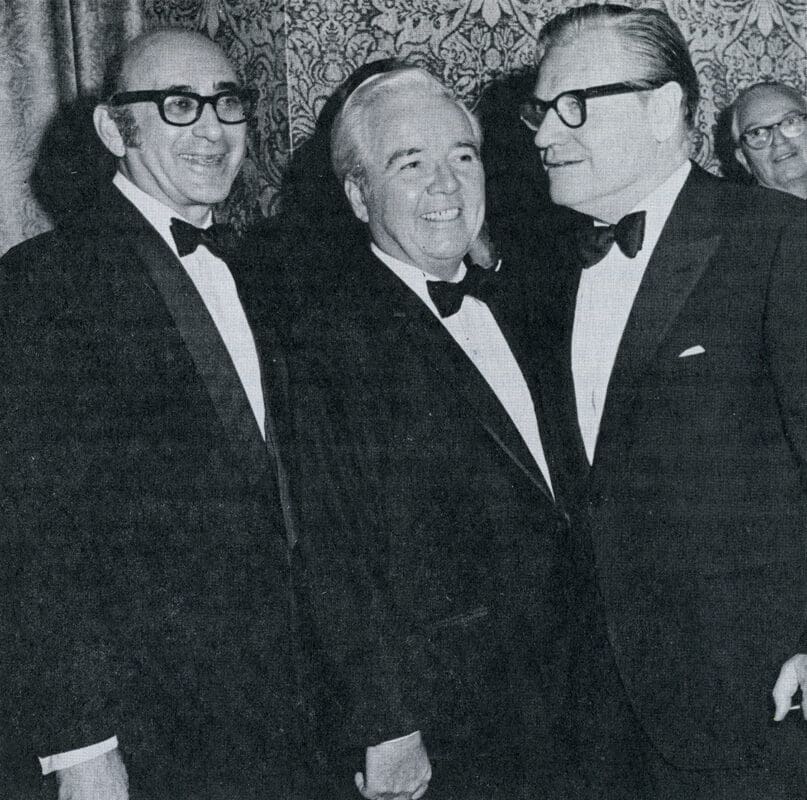
Senator William Conklin visits an occupational training center. (1977)Joseph T. Weingold,, Senator William T. Conklin, Nelson A. Rockefeller, Nassau County Rose Ball (1966)
They were long-term friends and cooperated in the legislative efforts to secure services for retarded children. With Conklin, Weingold authored many pieces of legislation that were to become state law. But Weingold actually met Conklin by chance, as the following anecdote told by Jack Gorelick conveys.
“You look at our OMRDD and you ask, who brought that about? You think legislation and again you know it was like a God send. Jerry Weingold and Billy Conklin… Bill Conklin on the train to Albany, you know, they’re sitting next to each other…And one guy says, ‘What do you do?” And the other says, ‘Well, I’m with AHRC and have a Mongoloid son…Bill Conklin says, ‘Well I have a Mongoloid son, too. And I was just elected State Senator from Bay Ridge…’ These guys wrote all the legislation. Jerry wrote it, and Conklin got it passed.” [end note 4]
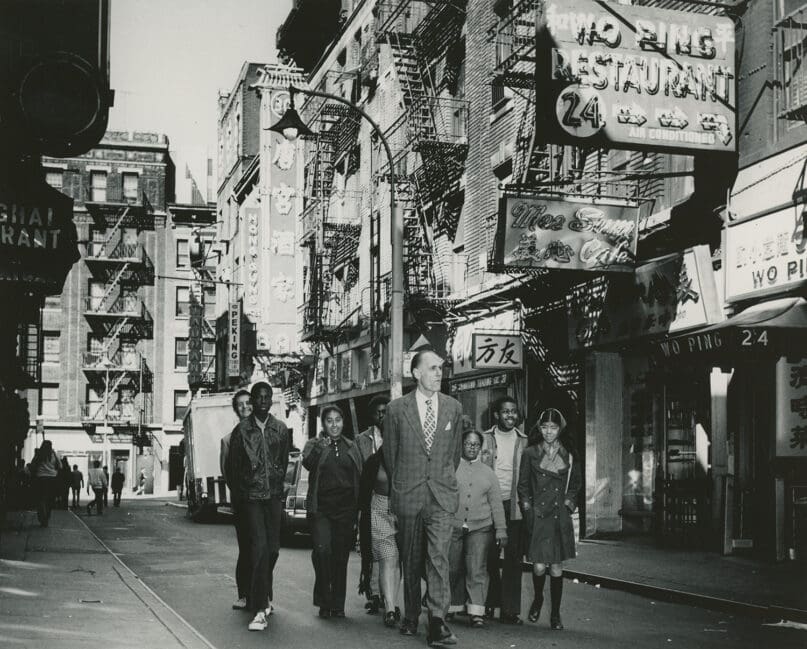
While the anecdotes about Weingold could literally fill a volume, as could his writings and poetry, l leave the reader with a seemingly trite but ultimately important observation about Jerry Weingold. When AHRC was pioneering travel training for persons with moderate mental retardation, Jerry Weingold was one of the strongest proponents of the program, even though everyone knew that risks were involved. Early travel training was described to me by Devino Riondato, the first teacher to be hired by AHRC for its pilot special education classes.
Devino Riondato walks in the community with students, 1950sDevino Riondato with students, 1950s
Because it had never been done before almost everyone involved had extreme apprehension. But Weingold realized and insisted that this program move forward because he realized the role independent travel would play in employment for the retarded. Despite his convictions and principled statements about travel training, he never allowed his son Johnny to engage in the program. Instead, Weingold would drive Johnny to the workshop each morning.
In a way this “inconsistency” in Weingold’s words and actions point to the complexity and contradictions of this man. At heart, and virtually everyone I spoke to about Jerry Weingold had absolutely no doubt on this point, he was motivated by his love for his son, with whom he maintained an extremely close relationship throughout his life. He may have been overprotective at times, as many parents of children with disabilities are wont to be. But, he followed his own advice to the AHRC parents to keep “our faith in our children” as he wrote in an early edition of “Our Children’s Voice.” That, he knew, was what would keep him, and them, going in their struggle.
Laying Out The Blueprint
George Hirsch, a two time President of AHRC, recalls Jerry Weingold’s efforts to formulate a general approach to the problem of mental retardation in the State,
“We laid out a program, cradle to grave. I sat with Jerry Weingold and two other people and said, ‘Let’s find out what we need now and what we need later…”
Weingold actually consulted with many persons in building AHRC’s plans to increase and improve community and institutional services for persons with mental retardation. As Mike Goldfarb pointed out in our interview, the actual implementation of this plan followed in large measure the maturation of the children of the founding parents. First were clinics, then classes, then workshops and so forth. The “proposed long-term program” was provided by Weingold in his in-house paper of May 17,1950 titled, ‘The Formation of Parents’ Groups and The Relation to The Overall Problem of Mental Retardation,’ a version of which later was published in the American Journal on Mental Deficiency(AJMD) (January, 1952: 484-492). The paper is for its time absolutely brilliant and prescient.
While Weingold can not be said to have laid out the entire field of mental retardation as we know it today, for example, he does not discuss self-advocacy or the closing of institutions, the degree to which he describes the basic problems and solutions to the situation of families who have children with mental retardation is, again given the era of these remarks, uncanny.
It should be remembered that Weingold was in contact with Lloyd Yepsen, who was at the Vineland School Research Department at that time and who had just served a term as President of AAMD. Yepsen was himself a brilliant and compassionate man who worked with Weingold in helping him to formulate AHRC’s plans. Weingold and his companions also had ties with Richard Hungerford, who was to serve as AAMD president from 1950-51 and whose October, 1949 article in the AJMD ‘Minimums of a State Program’ was actually adopted “in its entirety” by AHRC in its long range objectives. Dr. Helen Thompson and Dr. Clemens Benda also probably had some input into Weingold’s thinking. In actuality, many of the features of Weingold’s blueprint reflect ideas that had been adopted by professionals in the AAMD as early as 1940. In a mimeo document titled, “Practical State Program for Care of the Mentally Deficient” adopted 5-22-40 by the American Association on Mental Deficiency, we find six major areas explicated. [end note 5] The early AHRC blueprint for the overall development of services for people with mental retardation would appear to be informed by this earlier AAMD document, and Hungerford’s article.
But Weingold’s plan was not just a restatement of the professional plan, it was a “parentalized” version of it, that specifically identified and linked the parents’ interests with many of the above provisions. The AAMD suggestions are very sketchy and general, merely a kind of outline without content. Weingold’s paper is an eighteen-page exposition of the parent movement and its relationship to the development of services necessary to address “the overall problem of mental retardation.” It showed incredible self- and historical awareness, as well as demonstrated why persons who knew Jerry Weingold were so impressed with what was “between his ears.”
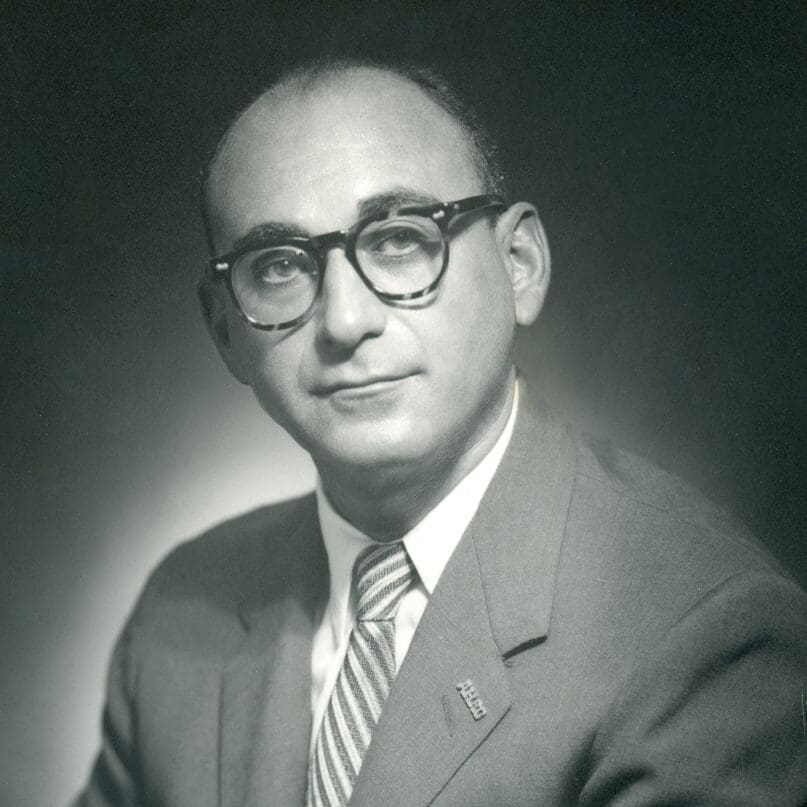
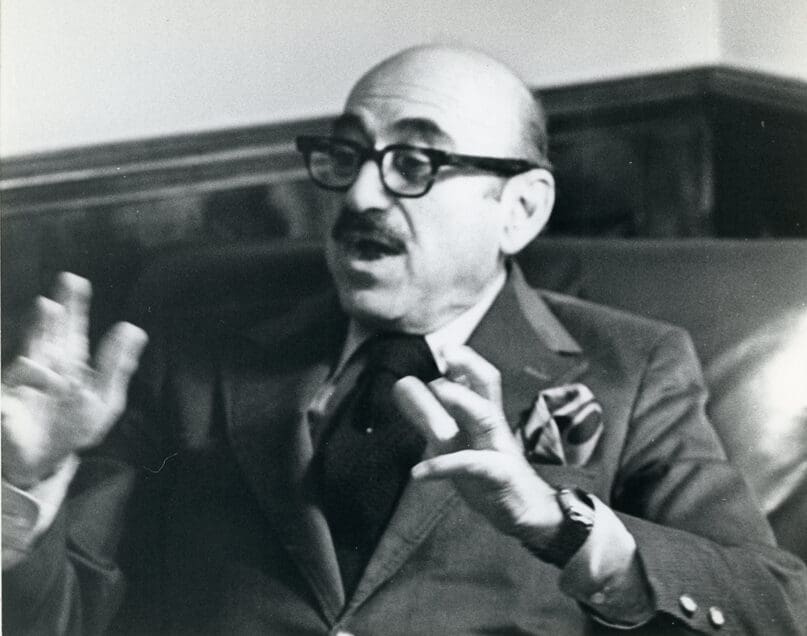
Joseph T. Weingold
Weingold began with an analysis of the parent movement, itself impressive in that AHRC was only one year old when the paper was written. In that part of the paper he emphasized how the parent movement was slow to start but quick to grow. He described some of the problems parents groups faced, and the difference between AHRC and the institutional-based groups. He also devoted considerable space to the problems inherent in parent groups, such as their heterogeneity and lack of organizational experience.
As we will see shortly, at this time AHRC had already made an impact in the City and State and had grown incredibly. In 1949 when it was incorporated the organization had a mailing list of about 200. In 1950 when Weingold wrote this paper, the mailing list was over 10,000 and included national and international entrees. Part of the early success of AHRC was a result of Weingold’s strategy to “enlist some of our critics to help us.” The organization had begun a steady stream of correspondence to governmental and professional groups. Some of these were put on an Advisory Board in order to incorporate new ideas and to encourage cooperation between parents and professionals. This is probably another reason why the plan announced in this paper reflects both professional and parent beliefs.
The blueprint began with a plea for educational services for children with mental retardation.
“It is our contention that it is the function of the community to provide training and educational facilities, not only for those considered eligible to the special classes in the school system (and many communities do not even have these classes) but also for those considered to be the ‘institutional type,’ whatever that means, on the basis of a certain I.Q. level…there is still too much reliance placed on I.Q. and similar tests all geared to the normal…Even if these children can only receive training in self-help and social adjustment, this should be a function of public education.” (pps. 8-9)
This text could have been written today. This is even more true when one considers that immediately before this paragraph appears Weingold calls for early education for retarded children, and as one can see from the above quote, for all retarded children, not only ‘educable’ ones.
The next part of the blueprint called for recreational, athletic and after school activities for children with retardation. Asserting that adolescents with retardation “are too part of the youth of this country,” he described the vocational training and active social life that is required for these youngsters. He was specific in his view that employment should include sheltered workshops and ordinary employment. The AHRC plan in 1950 was primarily concerned with children and young adults, although it did call attention to the plight of retarded persons more than sixteen years old and the need for services for them.
In addition to these kinds of community-based services Weingold called for, and specifically described AHRC’s attempts at establishing clinics for diagnosis, remediation, pre-schools and kindergartens for the youngest children.
While the program did include recognition that conditions in the state schools needed to be improved, Weingold was also clear about his preference for community-based services.
“It is our position, and we are joined by the progressive men directing State Schools, that a community program should be set up that obviates the necessity for institutionalization except in the cases of the most severely retarded.” (9)
One finds a discussion of the need for guardianship (Weingold eventually writes this legislation for the state), for research into the causes and prevention of mental retardation (he supported the foundation of the Institute for Basic Research on Staten Island), and adequate and realistic teacher preparation. He also mentioned the importance of parent training and support. He stressed the role that AHRC would have, as opposed to previous parent groups, in creating new legislation and implementing existing law. And Weingold described the importance of educating the public about the issues.
“A gigantic campaign of education [is needed]. Society tends to reject and shun what it does not understand. The misconceptions about mental retardation range from the ridiculous to the dangerous.” (11-12)
There was a very aggressive public awareness campaign launched by AHRC at that time that included letter writing, television and radio appearances, newspaper coverage and intensive networking. (see below discussion of the New York Times advertisement)
While the overall plan suggested in Weingold’s paper was not primarily geared towards adults or older persons with mental retardation, what it does lay out in a comprehensive way, is amazingly consistent with our current system of care. This is especially impressive given the conception of disability that was dominant in the field at that time. On the other hand, in this plan and other places he mentioned the need for psychotherapy for parents with retarded children, putting a slightly psychiatric spin on their situation. In many ways he, and the paper, evidenced a kind of awareness of mental retardation that is quite different from our own. But this only makes the relative comprehensiveness and correctness of his thinking about the overall future development of the field even more remarkable.
A “Nomenclature of Despair”
We have already encountered the parents’ experience of the nomenclature of mental deficiency. Weingold’s position on nomenclature in his paper seemed consistent with this experience.
“I should like to point out here that this would be an excellent time for the professional group in the field, the AAMD, to reexamine the semantics of mental retardation. We feel that we have been and are hampered in our work by the terms so long used to describe various forms and levels of retardation. Of course, Parents’ Groups must be realistic. They cannot afford to build false hope, but neither should they have to face a world with a nomenclature of despair. The terms used today are those of defeatism. Idiot, imbecile, moron, are no longer terms of art: they have been preempted by literature and cheap vaudeville. Their connotations are those arising from the novel and the low comedian. It is extremely unrealistic to ask Parents’ Groups to do a selling job with such unpalatable labels for wares which deserve better.” (14-15)
This concern with changing the terminology of professionals was a specific focus of the founding parents.
Another parent stated in our interview,
“They used to be called ‘Mongoloid Idiots.’ That was the term for them. To me, that was one of the greatest triumphs, along with the tangible edifices, nurseries, sheltered workshops…was getting the terminology changed. We lambasted these physicians and we got them to change…That was the beginning of a new terminology, which was not just more humane but so much more accurate and analytical.”
Later in the interview this parent emphasized that it was not just the stigma of the terms and the psychology of their effect on parents that was at issue. It was also the fact that the mission, the parents’ goals for their children, were seriously negatively effected by the terminology of despair. The parents found it difficult to portray a hopeful image about the development of services to “idiots” and “imbeciles.”
Ann Greenberg also said that it was one of the great victories of the parents groups to have influenced the professionals to change the nomenclature from that of mental deficiency to the current one of mental retardation.
Tracing the historical trail of the adoption of the term ‘mental retardation’ I believe that there is warrant for her and other parents’ a6ssertion, although AHRC was not the only group that was involved. Parents began being active in AAMD in the early 1950’s when discussions about a terminology change were just beginning. In 1952, for example, Elizabeth Boggs, a New Jersey parent who was eventually to become a powerful national figure in the field through NARC, attended a meeting of the AAMD Nomenclature Committee. Not only was the terminology of mental retardation advanced by this committee, its conception of mental retardation was remarkably contemporary. AAMD officially changed its terminology to that of mental retardation in 1959. While one cannot attribute this entirely to the role of parents and parent groups at the time, the pressure they applied on professional groups undoubtedly played a great factor in hastening the change. [end note 6]
The effort and vigor with which parents lambasted physicians probably accounts for why today many of them are still committed to the term “mental retardation” and have resisted recent efforts to change it.
While space does not allow for a full discussion of the issue, the reader is asked to permit a small digression on nomenclature in our field today. From the perspective of self-advocacy organizations today the term “mental retardation” has become objectionable. Many have pressured groups such as Association for Retarded Children or Citizens to remove the word “retarded” from their name. Thus, some years ago the NARC became known as “the ARC.” Other organizations have followed suit given the pressures from the self-advocates. It is ironic but understandable that this is occurring today.
The people pushing for the current change of terminology to a more humane and accurate one are the children of the founding parents.
Unfortunately, as is the way of all terms, the social conditions surrounding words ultimately gives them their real meaning. And the social conditions for persons with mental retardation in the 1950’s and 1960’s were still awful. They were stigmatized, exempted from regular education and given ‘special classes.’ And some were incarcerated in institutions experimented upon and abused because they were “mentally retarded.” Obviously this was not the intention of the parents in initially pushing for this term. They had no idea that, eventually, it would take on the “baggage of the era.” But it does seem sensible, given this history, that self-advocates who grew up in this era would have come to dislike the term and want a new one. [end note 7]
The view professed by Mike Goldfarb is that language itself has a limited power to effect the social processes through which people are devalued and oppressed. Indeed, positive language used in such situations can be euphemistic and misleading, actually enhancing devaluation. However, it is also true that language is not unimportant, and it does influence our perception of people– that is exactly why the founding parents objected to the old nomenclature. With limited time and resources, if one needs to make a choice, it is probably better to worry more about changing the social processes by which persons are demeaned than the language used in doing so. And certainly, as Goldfarb points out, “it is simple minded to think that calling people who are socially demeaned and diminished by a different name is going to have them cease to be diminished or demeaned.”
When I wrote that in a very real way the history of the mental retardation movement was the history of the parent movement it was intended in this literal way. Parents actually were largely responsible for hastening the change to a less stigmatizing terminology for their children. Furthermore, as Jack Gorelick put it, “all the good things happened because of the parents and in spite of the professionals. We professionals are the ones who brought them Willowbrook. [elbows my side with a sardonic grin] We are the ones who exempted their children.” Perhaps this is a bit one-sided; but just a bit.
Accomplishments of the First Years
In a mimeographed document (dated 1950 probably written in January or early February), AHRC reviewed its rapid development. The following are some excerpts from that document.
“As AHRC gained in publicity in newspapers, on the radio, in Parents Magazine, etc., parents by the hundreds flocked to parent education meetings. These monthly meetings were addressed by Mr. Stanley Levin, Dr. Lloyd Yepsen, Dr. Helen Thompson, Dr. Arthur Foxe, Mrs. Pearl S. Buck, Dr. Arthur Whitney, and Dr. Clemens E. Benda. Several of those mentioned were also asked to serve on AHRC’s Advisory Board, which also included the actor Drew Pearson.”
“AHRC published a pamphlet which details some of its long range objectives…“
“In autumn of 1949 AHRC representatives met with Dr. Frederick MacCurdy, Commissioner of the New York State Department of Mental Hygiene, Dr. Harry C. Storrs, Senior Director of Letchworth Village Training School, and Mrs. Crystal Potter, Deputy Commissioner of Welfare in the City of New York. The recommendations made at that conference are still under consideration by New York State authorities. Governor Dewey paid public tribute to the Association in his remarks at the ceremony. At the luncheon he promised to meet with members of the Association in the early part of 1950.
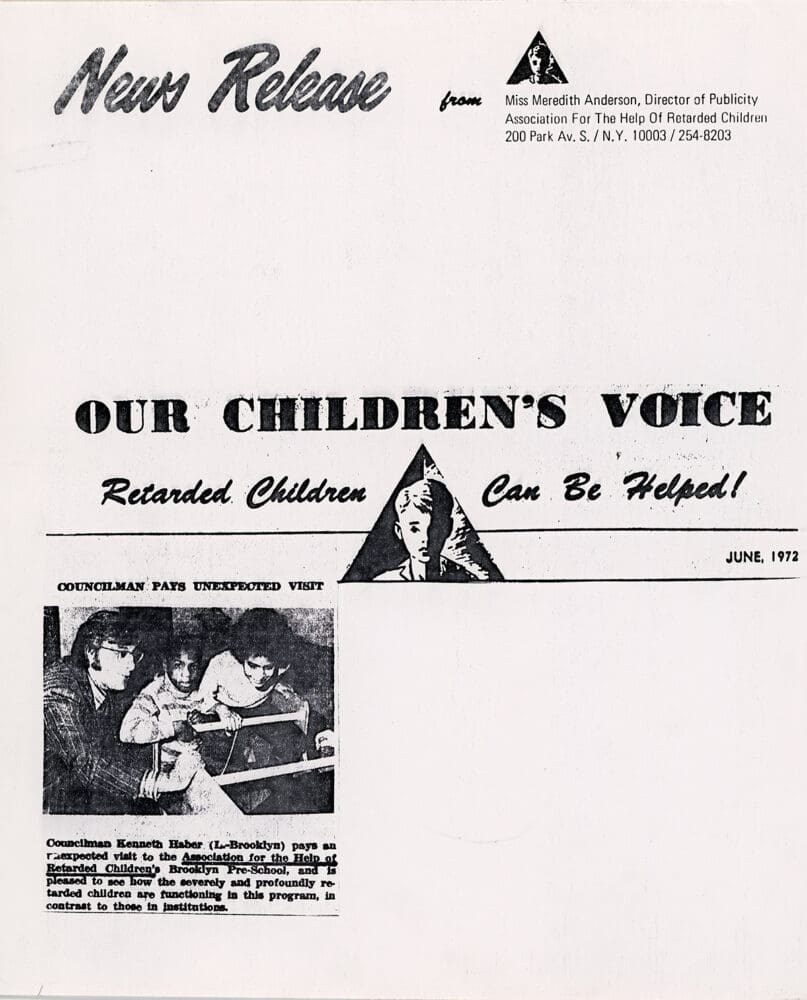
“The Association also publishes a monthly newspaper called “Our Children’s Voice” for which there is no subscription charge at this time.”
The document also indicates that AHRC had met with officials in the Board of Education and in social service agencies in New York City to begin discussing plans for pilot classes and clinics. Indeed, this was AHRC’s plan from the outset to set up pilot programs in New York City and then around the state. These pilots would demonstrate the feasibility of various ideas but in no way would they imply that it was not the duty of the State to provide these kinds of programs, clinics or classes. This is why in the early years almost all programs, except for parent education, were called by the term ‘pilots.’
It was announced in this early 1950 document that “AHRC is negotiating with a charitable organization in Brooklyn toward the establishment of the first clinic, and an announcement should be forthcoming.”
In addition to the achievements listed in this document, Ann Greenberg’s typed “A.H.R.C. New York City Chapter – Chronology,” provides information about the first year’s activities. These activities included the opening of an office at 1133 Broadway, the inauguration of a $100,000 fund drive, the government granting AHRC tax exemption, the winning of official endorsement of Emmanuel Cellar (Congressman from Brooklyn) and John Cashmore (Brooklyn Borough President) and in December of 1949, the Bronx House offering to AHRC of classrooms to be used five mornings a week.
By the beginning of 1950 AHRC had grown to be an organization of about 1,000 persons, 700 of whom were parents, the remainder interested professionals and relatives. Nearly $14,000 of the $100,000 drive had been collected and Chapters had been started in Westchester County, Sullivan County and Long Island. [end note 8] The parents were involved in networking activities, especially in finding other parents of mentally retarded children. In 1949 and 1950, they attended professional meetings such as the AAMD, served on The Committee of One Hundred in New York State, and went to the White House Conference on Children and Youth and served on the Project 4 (problems of the mentally retarded). AHRC actively engaged the other parent groups in the state for the purpose of coordinating efforts.
The first clinic was opened in February of 1950, just one year after AHRC’s incorporation, at Flower Fifth Avenue Hospital with Dr. Lawrence B. Slobody as Director, and with the support of Dr. Margaret Giannini. The first formal parent education courses began in March, and in April, as an adjunct to Flower-Fifth Avenue Clinic, the Lena Invalid Society donated $6,000 to allow for the opening of a speech clinic.
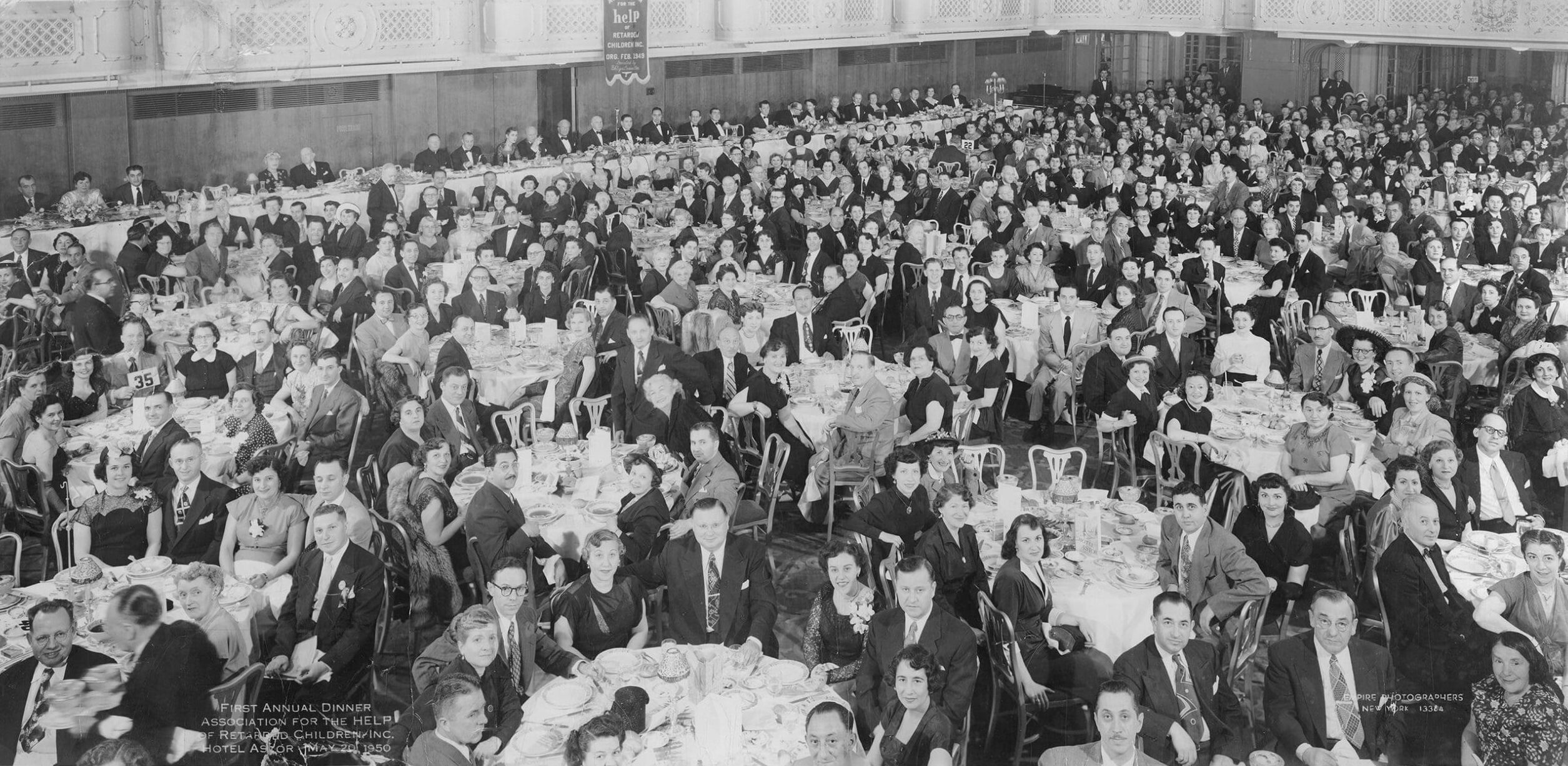
The First Annual Dinner of AHRC was held on May 20, 1950 at the Astor Hotel.
The first annual dinner, Hotel Astor (1950)
It marked the tradition of annual dinners and awards that would come to characterize AHRC, and still does. The public relations value of these ceremonial gatherings was clearly appreciated by the AHRC leadership from the outset. Huge efforts were made to have this first Annual Dinner be impressive in quality and scale, even though the organization was still relatively small and poor. In the dinner program, photos and statements from Governor Dewey, Pearl Buck, Drew Pearson, Cong. Emmanuel Cellar, and Richard Hungerford appear. Jack Max, the Chairman of the Dinner Committee, makes special mention of the contributions of City Coordinator Albert Leavitt, who “gave so unstintingly of his valued time and talents” even though not a parent. Max specifically mentions the members who “worked evenings and weekends…and ran their household by remote control…these men and women taught me what the words ‘unselfish devotion’ mean.” The scale, political maneuvering and public imaging involved in the First Annual Dinner would have been impressive for any organization, let alone one staffed by volunteers, with a professional staff of one and that had been in existence a little over one year!
As was mentioned, public awareness of AHRC was a critical concern of the founding parents. Ann’s chronology of early achievements mentions the advertisement taken by AHRC in the New York Times in December of 1950. As part of the public education campaign, the advertisement used pity and compassion to raise money for the organization by putting the picture of a physically challenged child coupled with the caption “This is a picture of a crippled child.” Just below the picture a further statement was printed indicating that you may not be able to see his disability because “it is his little brain that is crippled.” This was an important ad in the history of AHRC, an expensive one that was paid for by having many small donating organizations whose names appeared in a list to the right of the advertisement. Through this ad, AHRC became known in New York, around the country, and even the world. The ad was both a device for public education about children with mental handicaps, and a fund-raising and membership tool. It was highly successful on all accounts. Not only was the ad influential in its era, for example, after reading it President Eisenhower asked that the author should “write the proclamation I sign…” for National Retarded Children’s Week. Years later AHRC was still including it in their information package sent to prospective members.
Understanding the power of media, what it could do for the parents’ cause, and the incredible efforts in this area undertaken by the parents in the first year of AHRC’s existence, are two reasons cited by Alfred Katz in 1957 in explaining the success of AHRC. The other reason was the incredible persistence of parents in networking with other parents of children with mental retardation and getting them involved in the cause. The degree of networking and public education is reflected perhaps most impressively by the growth of the mailing list from 200 to 10,000 in the first year.
Ancillary to these New York City and State focused activities, Weingold was also instrumental in initiating and establishing a national parents’ group. He had proposed such an idea in a paper, and certainly to other parents around the country before attending the AAMD meeting in Twin Cities, Minnesota at the end of September/beginning of October, 1950. In Lerner’s history of AHRC and elsewhere, Weingold is given credit for having proposed the idea to other parents around the country. These parents met at the AAMD meeting and drafted a document titled, “Recommendations of The Steering Committee of Parents of Retarded Children Groups With Regard to the Formation of A National Organization of such Groups.” It was a manifesto-type statement with enumerated goals and a call for participation. It was signed by five parents: Allen Sampson of the Washington group, Irving Bieber from Los Angeles, Eleanor Hayes from Massachusetts, Alfred Kamm of Dayton Ohio, and Joseph T. Weingold of AHRC New York City.
In the January-February, 1951 edition of Our Children’s Voice, AHRC’s accomplishments for the previous year are described: two diagnostic clinics, a speech clinic, play therapy groups, a social activities program for children, a vocational training program, summer camp scholarships, parent education courses, and public enlightenment. Weingold had also contacted the Division of Vocational Rehabilitation and Goodwill Industries about beginning job placements for mentally retarded youth and adults. Also by this time AHRC was leading a movement to create a coordinating body or council that would represent these groups in a united front to the legislature. Finally, in February of 1951, AHRC was formally admitted to the Greater New York Fund, entitling it to receive contributions. Indeed, AHRC was denied membership to the Fund in early 1950 on the basis that it had no Executive Director, which is partially what motivated the hiring of Weingold. Normally the guidelines said that an organization had to exist for three years to be eligible for funds. Weingold secured membership in two years.
The reader should not come away with the impression that AHRC was only victorious in its first years. Politically changing the system in New York State was going to be much more complicated than the initial endorsements by political figures would have indicated. For example, Weingold and other parents wanted very much for the State to appoint a special committee to consider the overall problem of mental retardation in the state. Governor Dewey, whose public posture toward AHRC was highly supportive, essentially killed in committee the bill introduced by Senator Earle Brydges and Assemblyman Sam Roman. Our Children’s Voice (Vol.III, March-April, 1951: p.2) devoted several pages in its history of AHRC documenting the tactics used by the Association and its advisers, Chris DeProspo and Richard Hungerford, to try and get the legislation passed. The events and meetings cover three pages, single-spaced. The Association failed in its first attempt– a disappointing failure but one not to set them back! In an editorial in that same edition of Our Children’s Voice an editorial credited to the Board, was titled “The Resolution That Died of Kindness,” in which it was claimed that AHRC suffered defeat on this issue because its approach was too soft, it did not rally public opinion and it was too diplomatic. It called for building a “fighting spirit” while being careful not to “make enemies of the powers that be.” But it was also vowed that no such resolution would ever die again as a result of insufficient pressure or over politeness.
The saga of this legislation does not end here. Only a few months after it was killed in committee, it was reintroduced by the same state legislators, this time with the benefit of additional support within government and in the community (the legislation was the focus of AHRC’s first statewide conference). While the legislation again failed, Governor Dewey, in a compromise proposal, authorized a survey of the “extent and care of mental deficiency” and $25,000 for this purpose. AHRC wanted a Legislative Committee to be appointed and wanted parent representation on the study. Dewey’s compromise was intra departmental, without parent representatives, and with limited funds. Nonetheless, it was regarded as a victory by Weingold and the other parents, even though it was a compromise.
Lerner comments,
“It appears that AHRC had mustered its forces well. It worked together with the parent groups for institutionalized retardates…on influencing the governmental department first…The result was a compromise that authorized serious study of the problems of retardation…By hailing it as a victory, the Association had apparently begun to accept the compromising nature of the American political system.”(64).
Later in 1952 Weingold was appointed to the Advisory Committee of the study that was to be done by the Department of Mental Hygiene. This actually gave parents some say in the decision-making process surrounding that study.
Despite this development and the increased awareness of parents of retarded children by legislators, AHRC continued to experience defeat in terms of its early legislative proposals. One of its earliest programmatic focuses was on building services in the community for children with I.Q.s below 50. Initial attempts were made to influence legislators to examine this problem. Again the parents experienced considerable political indifference and resistance. In 1953, an omnibus bill to the Legislature proposed by Assemblyman Roman and Senator Brydges was killed in the Finance Committee of the Senate and Ways and Means Committee of the Assembly. Weingold called for additional emotional pressure to make the legislators see their responsibility to children with retardation (Our Children’s Voice, March, 1953). The response of AHRC was to present the same legislative proposal the next year, with the additional proviso that classes for trainable should also be started in institutions and state schools (thus involving the State Department of Education in institutional services), and also a phasing in period for classes for this population. Standards were proposed for entry into these classes. The proposal had even broader backing than the original one, including the support of the State Federation of Women’s Clubs and the State Teachers Association.
In response to the increased political pressure on March 11, 1954 Governor Dewey recommended an allocation of $50,000 for experimental classes for severely retarded children to be set up– five in the city, two in up state and five in state schools. This proposal passed the Legislature unanimously. The same type of pattern can be seen here as with earlier AHRC efforts, for example, the issue of the special study commission on the problem of mental retardation in the state. Initial resistance and failure is met with insistence, perseverance, increased networking, and public opinion mustering. Eventually the parents would achieve some form of a ‘victory.’
Looking back at the first years of AHRC under the guidance of Jerry Weingold, one cannot help but be overwhelmed at the amount of effort these parents put forth as well as their relative success.
At the same time, I do not want to give the false impression that things came easily to them, or that they did not experience many defeats along the way. The brief vignettes about initial attempts to influence government and service systems were included to illustrate this. In fact, success did not come easily to the parents during these years. The political climate in America was not ripe yet for their message. Throughout the 1950’s AHRC grew at a relatively slow pace. Its primary value during this period was in creating public awareness of the overall problems of people with mental retardation, effecting legislation, and demonstrating the feasibility of AHRC’s long range proposals through the establishment of pilot classes, workshops and educational programs.
AHRC initiated thinking about the overall problem of mental retardation on the City, State and national level. Among parent associations AHRC was clearly the leading association of this era. It gave the parent movement both vision and, as Jim Murphy (President of AHRC, 1974-77) put it, “it created scale.” Of course not all the changes in the State or City at the time are strictly the result of parent groups’ political pressure. Other bodies and professional groups also contributed in their own right. But, there can be no doubt about who was in the lead, and that was the parents.
This then brings us to Weingold’s often used quote in documents of this era, paraphrased in the title to this chapter, “An Idea Whose Time Has Come.” The quote is from the French Enlightenment philosopher, Voltaire, and reads, “There is only one thing greater than all the armies of the world, that is an idea whose time has come.” This statement summarizes the spirit of the founding parents of AHRC more than any other, which is probably why Weingold used it often to close his documents and speeches. He and the other parents felt they were involved in a righteous cause. They were in a battle for the lives of their children. Often he would joke and indicate his optimism about their ultimate victory when other parents expressed doubt. He would remind them that “our cause is just.” The way he saw it, the parents were going to win; they had to. They would do whatever it took. And they did.